
Smart livestock systems can use connected devices to monitor location, movement, health-related indicators, grazing behavior, geofencing, and other operational data. Livestock monitoring is one of the agricultural applications identified by the LoRa Alliance, and LoRaWAN-based solutions have been applied to cattle and other animal-production environments.
From an antenna perspective, however, livestock monitoring creates a very different problem from soil sensors or fixed irrigation controllers.
A cattle collar, ear tag, leg-mounted device, or other wearable node is constantly moving. Its orientation changes as the animal walks, grazes, lies down, drinks, or turns its body. The antenna may be only a short distance from the animal, while the entire device may need to fit inside a compact, sealed enclosure.
As a result, designing a reliable LoRaWAN livestock antenna requires much more than matching the nominal LoRa frequency.
The antenna, product enclosure, animal body, mounting method, gateway location, polarization, and real movement pattern should be evaluated as one communication system.
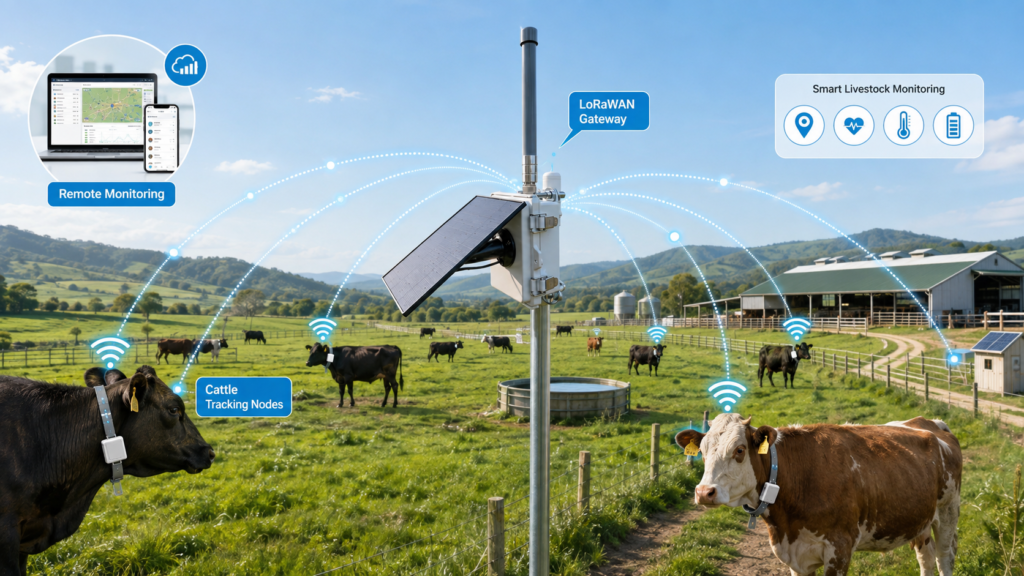
Why Livestock Tracking Is Different From Fixed Farm Sensors
A fixed soil sensor normally stays in one orientation. Once its position is known, engineers can optimize antenna direction and gateway placement around a predictable geometry.
A livestock tracker is different.
During one day, the same device may be:
- vertical while an animal is standing;
- tilted while walking;
- nearly horizontal while grazing;
- close to the ground while lying down;
- partially shielded by the animal’s body;
- surrounded by other animals;
- inside a shed at one moment and in an open pasture later.
This means the propagation path is continually changing.
A link that looks excellent when an engineer holds the tracker upright in an open field may not represent actual service conditions.
1. The Animal Becomes Part of the RF Environment
Wearable antennas operate close to the body.
The animal is therefore not simply “next to” the antenna. It becomes part of the electromagnetic environment seen by the antenna.
Antenna tuning, efficiency, radiation pattern, and impedance can change when a small antenna is placed close to a large body containing significant water and biological tissue.
The exact effect depends on antenna structure, spacing, enclosure, frequency, and mounting position.
This is similar in principle to many other embedded antenna problems: an antenna tested by itself may behave differently when installed beside a battery, display, PCB ground, metal part, or other nearby material.
RFLink discusses this system-level behavior in its VSWR guide and internal versus external antenna guide.
For livestock devices, the practical conclusion is important:
Test the antenna in the final product and in a representative mounted condition, not only in free space.
2. Compact Devices Make Low-Frequency Antennas More Difficult
Many livestock tracking devices are intentionally small and lightweight.
But Sub-GHz antenna design becomes increasingly challenging as available antenna volume shrinks.
An antenna designed for a LoRa band cannot be reduced indefinitely without changing its electromagnetic behavior. Compact designs may rely on meandering structures, matching networks, PCB ground interaction, spring structures, or flexible antennas to achieve practical integration.
The enclosure can further limit the design.
A cattle ear tag, for example, may need:
- weather protection;
- impact resistance;
- a battery;
- a PCB;
- sensors;
- GNSS hardware in some designs;
- a mounting or locking mechanism.
All of these compete for physical space.
The antenna should therefore be considered at the beginning of the mechanical design rather than added to whatever volume remains at the end.
RFLink’s existing FPC antenna selection guide and PCB antenna resources are useful references when deciding how an embedded antenna interacts with the device structure.
3. Orientation Changes Make Polarization More Complicated
Many fixed LoRa gateway antennas use linear polarization, often with the antenna mounted vertically.
For a fixed sensor, engineers can usually install the node antenna in a compatible orientation.
A livestock device does not stay still.
A collar rotates around the neck. An ear tag moves as the head changes direction. An animal may face toward or away from the gateway.
This means polarization alignment varies over time.
RFLink’s antenna polarization guide explains why polarization mismatch can reduce received signal level even when the antennas use the correct frequency.
For a moving LoRa device, the objective is therefore not to achieve one ideal orientation in a laboratory. It is to achieve acceptable behavior across the range of orientations expected in real use.
This can influence antenna placement, radiation pattern targets, mechanical layout, and field-test methodology.
4. Do Not Let the Battery Dictate the Antenna Position
Battery-powered livestock trackers often allocate a large fraction of their internal volume to the battery.
This creates a common integration problem: the only remaining space for the antenna may be directly beside or behind the battery.
That may not be the best RF position.
Depending on the structure, moving the antenna only a small distance, changing its orientation, modifying PCB clearance, or adjusting the enclosure layout can produce a more useful design than simply choosing a different catalog antenna.
The feed cable must also be controlled if an FPC antenna is used.
A cable crossing the antenna area or repeatedly changing position during assembly can change production consistency.
For this reason, the mechanical design should define:
- exact antenna position;
- keep-out area;
- cable routing;
- battery position;
- fastening method;
- enclosure spacing;
- assembly tolerance.
This is where device-level antenna tuning becomes valuable.
5. External Antenna or Embedded Antenna?
For wearable livestock devices, an embedded antenna is often mechanically attractive because there is no exposed element for the animal to damage.
However, an external antenna may still be appropriate for certain larger devices, fixed feeders, watering systems, gates, machinery, or livestock infrastructure.
A simple decision framework is:
| Device | Likely priority | Possible antenna type |
|---|---|---|
| Ear tag | Very compact, impact resistant | Customized PCB/FPC/embedded structure |
| Collar tracker | Integrated, durable, moving orientation | Embedded FPC/PCB/custom structure |
| Fixed water monitor | Outdoor durability | External waterproof antenna |
| Barn controller | Reliable building coverage | Rubber or external antenna |
| Farm LoRaWAN gateway | Wide-area coverage | Elevated fiberglass antenna |
The final selection still depends on the product structure and deployment.
6. The Gateway Must Cover Where the Animals Actually Move
A gateway placed beside the farmhouse may work well near the building but poorly at a remote water point, tree line, valley, or grazing area.
Livestock networks should therefore be designed around animal movement zones rather than administrative boundaries on a site plan.
Useful planning inputs include:
- grazing areas;
- barns and sheds;
- water points;
- feeding areas;
- fences and gates;
- hills or depressions;
- tree lines;
- seasonal pasture areas.
The LoRa Alliance highlights wide-area animal monitoring as a major smart-agriculture use case because livestock assets may operate far from conventional communications infrastructure.
For an outdoor farm gateway, an elevated omnidirectional fiberglass antenna can be a practical option when animals are distributed around the site.
RFLink’s 868 MHz fiberglass LoRa series and 915 MHz fiberglass LoRa series are examples of gateway-oriented external antenna formats currently available on the site. Their operating bands and regional suitability still need to be matched to the actual deployment.
7. Gateway Height Usually Matters More Than Marketing Range Claims
It is tempting to evaluate a livestock system by asking how many kilometers the radio can cover.
That question has no universal answer.
Communication range depends on the complete link budget and environment, including:
- transmit power;
- receiver sensitivity;
- spreading factor and network settings;
- antenna efficiency;
- antenna gain and pattern;
- cable loss;
- gateway height;
- terrain;
- vegetation;
- buildings;
- animal-body shadowing;
- interference.
Gateway height often helps because it can reduce local obstructions, but it should not be separated from radiation pattern and feeder loss.
For example, moving a gateway antenna higher may improve line-of-sight conditions, while using an unnecessarily long coaxial cable can introduce additional loss.
The system must be optimized as a whole.
8. Higher Gain Is Not a Substitute for Better Geometry
A high-gain antenna does not create RF energy.
It redistributes energy into a different radiation pattern.
For a large, relatively flat pasture, a higher-gain omnidirectional gateway antenna may be useful if the nodes are mainly distributed around the horizon.
For a hilly ranch with animals above and below the gateway, a narrower vertical beam could become less desirable.
RFLink’s antenna gain guide explains why the gain number alone should not determine antenna selection.
The same rule applies to livestock tracking:
Choose the radiation pattern for the geography, not the largest dBi value in the catalog.
9. Field Testing Must Include Movement
Static testing can hide livestock-specific problems.
A better validation plan should include multiple orientations and behaviors.
For a collar, engineers could evaluate:
- antenna side toward the gateway;
- antenna side away from the gateway;
- collar rotated;
- animal standing;
- grazing position;
- animal close to the ground;
- device inside a barn;
- device near a water tank or metal fence;
- devices among a group of animals.
The purpose is not to guarantee identical RSSI at every position. That is unrealistic.
The purpose is to identify whether normal movement causes unacceptable communication gaps.
10. Test More Than VSWR
VSWR is useful for checking impedance matching, but a good VSWR curve does not automatically mean a wearable antenna radiates efficiently when placed on an animal.
A complete evaluation may include:
- impedance / return loss / VSWR;
- antenna efficiency;
- radiation pattern;
- gain;
- sensitivity to body proximity;
- orientation sensitivity;
- assembled-device testing;
- real farm packet performance.
This is especially important when the final device is compact.
An antenna can be well matched while still losing useful radiation efficiency because of the surrounding product structure.
11. Production Consistency Matters
A prototype may perform well while mass-produced devices vary.
Potential causes include:
- FPC antenna position changing during assembly;
- coax cable routing varying between units;
- adhesive position changing;
- enclosure tolerance;
- battery position tolerance;
- plastic material changes;
- screws or metal hardware moving closer to the antenna.
For a livestock tracker manufactured in volume, the antenna installation method should be repeatable.
A mechanically defined fixture, locating feature, adhesive zone, or cable route can reduce RF variation between units.
When Does a Custom LoRa Antenna Make Sense?
A standard antenna can be perfectly suitable when the device has enough space and a conventional RF environment.
Customization becomes more useful when:
- the enclosure is unusually small;
- the antenna must sit close to the animal;
- standard antennas detune after assembly;
- a defined radiation pattern is needed;
- the battery occupies most available space;
- the cable or connector must be customized;
- several regional frequency versions are required;
- production consistency is difficult to control.
RFLink’s current custom antenna development positioning is built around this type of device-level integration rather than only supplying an isolated antenna component.
FAQ
What antenna is suitable for a LoRa cattle collar?
There is no universal antenna type. Compact collars often use an integrated PCB, FPC, spring, or custom antenna. The correct design depends on enclosure size, battery, body spacing, frequency band, and required performance.
Does the animal body affect LoRa antenna performance?
It can. A wearable antenna operates very close to the animal, so the nearby body can change antenna tuning, efficiency, and radiation behavior.
Why does a livestock tracker have different RSSI as the animal moves?
Orientation, polarization, body shadowing, terrain, vegetation, and multipath can all change the radio path as the animal moves.
Should the gateway use a high-gain fiberglass antenna?
It may be appropriate for some farms, but higher gain is not automatically better. The radiation pattern should match gateway height, terrain, and animal distribution.
Should livestock antennas be tested on the final device?
Yes. Free-space antenna data alone cannot represent the complete wearable environment.
Conclusion
LoRaWAN is useful for livestock monitoring because farms often need low-power connectivity across widely distributed assets, but the antenna engineering problem is more difficult than it first appears.
A wearable node moves constantly, changes polarization, operates close to the animal body, and often has very little available antenna space.
For this reason, a reliable LoRaWAN livestock antenna should be developed as part of the complete device rather than selected as an isolated component.
Early attention to enclosure design, battery placement, antenna clearance, radiation pattern, gateway location, and representative field testing can reduce problems much more effectively than trying to correct poor coverage after the product enters deployment.