
Antenna gain is a key specification used to describe how an antenna directs radio frequency energy in a certain direction. It is usually measured in dBi. In simple terms, antenna gain tells us how effectively an antenna focuses signal energy compared with an ideal reference antenna.
Antenna gain does not mean the antenna creates extra power. Instead, it changes how the signal is distributed. A higher gain antenna can send more energy in certain directions, while reducing energy in other directions.
This makes antenna gain an important factor in antenna selection, especially for wireless devices that require specific coverage distance, direction, or installation conditions.
What Does dBi Mean?
dBi stands for decibels relative to an isotropic antenna. An isotropic antenna is a theoretical antenna that radiates signal equally in all directions. Real antennas do not work exactly like this, but dBi gives engineers a useful way to compare antenna performance.
For example, a 2dBi antenna usually provides broader coverage, while an 8dBi or 12dBi antenna may provide stronger signal in a narrower direction. The best choice depends on the application, not just the number.
Does Higher Antenna Gain Mean Better Performance?
Not always. One of the most common misunderstandings is that higher antenna gain always means better performance. In reality, the right antenna gain depends on the application, installation environment, frequency band, and coverage requirement.
A high gain antenna can improve signal distance in a specific direction, but it may reduce coverage in other areas. For example, a high gain directional antenna may be suitable for point-to-point communication, outdoor base stations, or long-distance links. However, it may not be ideal for a small indoor device that needs stable signal coverage in multiple directions.
For many IoT devices, routers, meters, and handheld wireless products, a moderate gain omnidirectional antenna may provide more practical performance.
Antenna Gain and Radiation Pattern
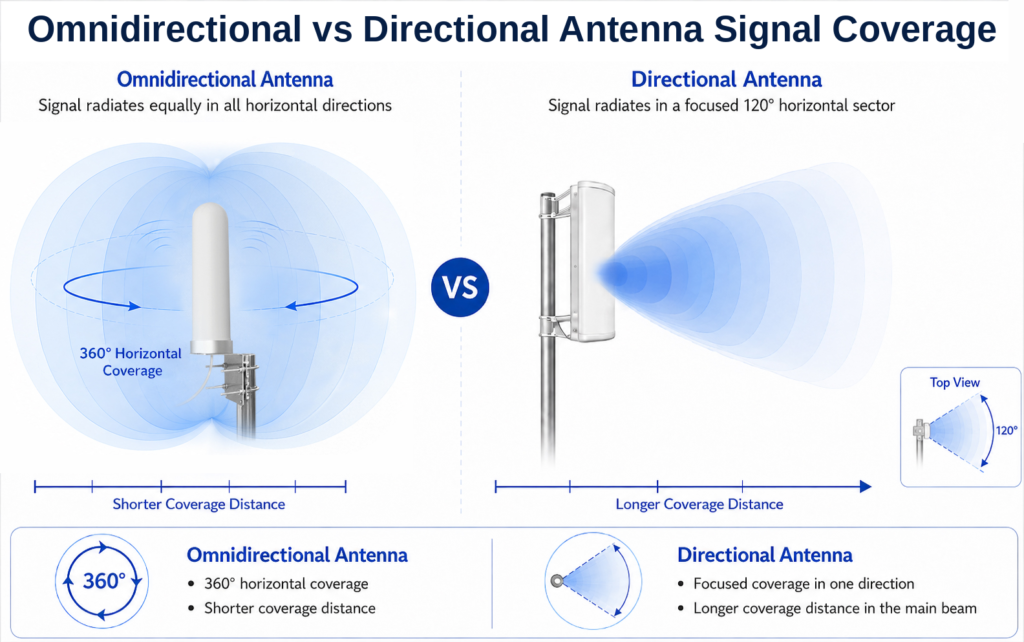
Antenna gain is closely related to the radiation pattern. The radiation pattern shows how the antenna distributes signal energy in space.
An omnidirectional antenna radiates signal around the antenna in a wide horizontal area. It is often used when the device needs to communicate with receivers in different directions. Rubber duck antennas, fiberglass antennas, and some magnetic mount antennas are common examples.
A directional antenna focuses signal toward a specific area. Sector antennas and parabolic antennas are typical examples. These antennas are useful when the signal needs to cover a targeted direction or longer distance.
How Antenna Gain Affects Signal Range
Antenna gain can affect signal range, but it is not the only factor. Frequency band, transmit power, receiver sensitivity, cable loss, installation height, obstacles, and environmental interference can all influence wireless performance.
For example, replacing a low gain antenna with a higher gain antenna may improve communication distance in some cases. But if the antenna is poorly matched, installed too close to metal, or used in the wrong orientation, the actual performance may still be poor.
This is why gain should be evaluated together with VSWR, efficiency, impedance matching, and real installation conditions.
How to Choose the Right Antenna Gain
When choosing antenna gain, consider these questions:
- Does the device need wide coverage or focused coverage?
- Is the antenna used indoors or outdoors?
- Is the device fixed or moving?
- What frequency band does the product use?
- Are there walls, metal structures, or other obstacles nearby?
- Does the antenna need to fit inside a compact product?
For example, a GNSS antenna may need stable reception from satellites above the device. A sector antenna may need to cover a specific outdoor area. A rubber duck antenna may need balanced performance for general wireless communication.
When Custom Antenna Design Helps
If a standard antenna cannot provide the right balance of gain, size, frequency, radiation pattern, and installation method, custom antenna design may be needed.
A custom antenna solution can help optimize:
- Gain level
- Radiation pattern
- Frequency band
- Mechanical structure
- Cable and connector type
- Installation method
- Performance after integration into the final device
This is especially important for products where antenna performance changes after assembly or where standard antennas cannot meet the required coverage.
FAQ
Is higher antenna gain always better?
No. Higher gain provides more focused signal energy, but it may reduce coverage in other directions.
What is a good antenna gain?
There is no single best value. The right gain depends on frequency, application, coverage requirement, and installation environment.
What does dBi mean?
dBi is a unit used to compare antenna gain with a theoretical isotropic antenna.
Can antenna gain improve signal range?
Yes, in some cases. But signal range also depends on transmit power, frequency, obstacles, cable loss, and antenna installation.
Conclusion
Antenna gain is an important part of antenna performance, but it should not be judged by a higher number alone. The best antenna gain depends on how and where the wireless device will be used.
If your device requires a specific coverage range, radiation pattern, size, or installation structure, our RF engineering team can help develop a custom antenna solution from design to production.