
Orchards and vineyards are attractive environments for LoRaWAN-based monitoring.
Distributed sensors can be used to collect soil, microclimate, weather, irrigation, water-level, equipment, frost-risk, and other agricultural data across areas where running power and communication cables to every location would be impractical. Crop production and environmental monitoring are established smart-agriculture use cases for LoRaWAN.
But orchards and vineyards also create a propagation challenge that is easy to underestimate.
Rows of trees or vines may extend hundreds of meters through an agricultural property. Foliage density changes through the season. Rain and irrigation change the moisture condition of the canopy. Trellises, support wires, posts, machinery, terrain, and elevation differences all alter the RF environment.
A LoRaWAN orchard antenna therefore has to be selected as part of the whole deployment, not as an isolated component.
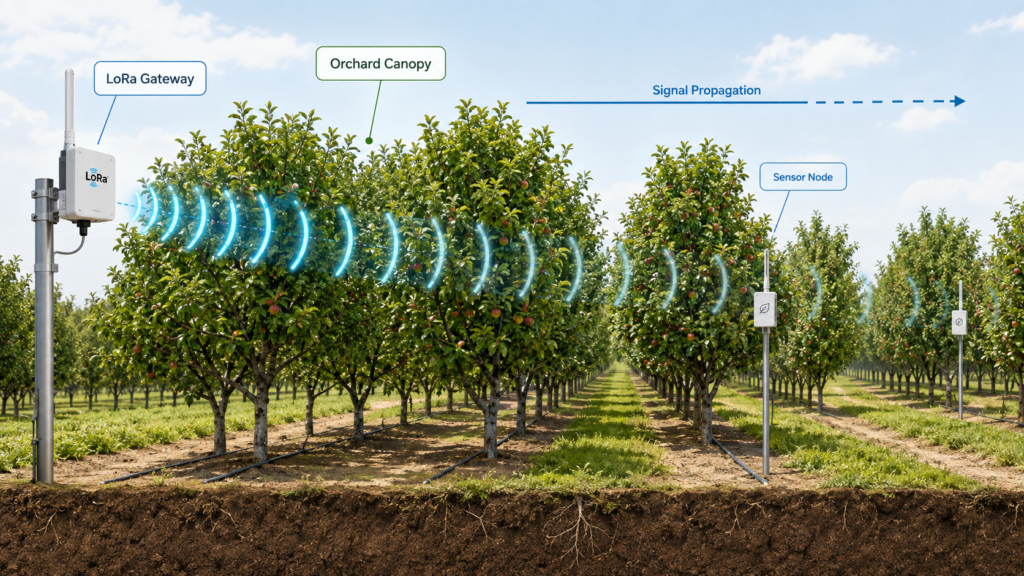
Open Farmland and Orchards Are Not the Same RF Environment
A flat field after harvest may offer relatively open propagation.
A mature orchard can look completely different.
The radio path may pass through multiple tree rows, trunks, branches, leaves, irrigation pipes, trellis systems, and wet vegetation before reaching a gateway.
A vineyard introduces its own geometry. Long rows can create different propagation conditions depending on whether the gateway is aligned along the rows or the signal must travel across many rows.
This creates an important planning principle:
The same distance does not necessarily represent the same RF difficulty.
A node 600 meters away with relatively clear propagation may communicate more reliably than a node 300 meters away behind dense vegetation and terrain.
This is why maximum-distance claims are rarely useful by themselves when planning a real agricultural network.
1. Vegetation Changes During the Growing Season
One of the defining characteristics of an orchard or vineyard is seasonal change.
At one point in the year, the canopy may be sparse. Later it may be dense and contain substantially more water-bearing vegetation.
That change can alter the RF path.
If the network is commissioned only during a low-foliage period, engineers may overestimate the margin available during the peak growing season.
A more useful test plan includes representative crop conditions rather than one convenient date.
For orchard applications this may mean comparing:
- early-season foliage;
- mature canopy;
- dry conditions;
- wet conditions after rain or irrigation;
- harvested or dormant conditions where relevant.
The objective is not to prove that foliage always causes a fixed number of decibels of loss. There is no universal value because species, water content, geometry, frequency, and path length all differ.
The objective is to build enough link margin for the real deployment.
2. Wet Vegetation Can Be Different From Dry Vegetation
Water is an important part of the RF environment around agricultural plants.
The important issue is not simply atmospheric humidity. It is the physical vegetation and moisture present along the propagation path.
Leaves, fruit, branches, and wet surfaces change the electromagnetic environment encountered by the radio wave.
This is one reason a network should ideally be evaluated during representative agricultural operating conditions rather than only on a dry installation day.
For irrigation-related LoRa deployment challenges, RFLink already has a separate guide covering smart irrigation and pump station LoRa antennas. That article focuses more heavily on control boxes, pumps, water channels, and metal cabinets, while orchard deployment adds canopy and terrain as major variables.
3. Gateway Height Can Change the Entire Network
In many orchard deployments, gateway antenna height is one of the first variables worth investigating.
A gateway antenna mounted at low height may force the RF path through many rows of trunks and foliage.
Raising the antenna can sometimes reduce the amount of vegetation in the direct propagation path and improve the geometry toward distant nodes.
Possible gateway locations include:
- farm buildings;
- pump houses;
- weather-station towers;
- dedicated poles;
- hilltops;
- elevated utility structures;
- central high points.
However, “higher” should not become an unlimited design rule.
A higher antenna can require a longer coaxial feed, stronger mounting structure, lightning protection, and more difficult maintenance.
The useful question is:
How high does the antenna need to be to improve propagation without creating unnecessary feeder and installation problems?
4. Keep the RF Cable Short When Possible
If a fiberglass antenna is mounted high above the gateway electronics, the coaxial cable becomes part of the link budget.
Longer cable means more RF loss.
The exact loss depends on cable type, length, connectors, and operating frequency.
For this reason, a network designer should not optimize antenna height while ignoring the feeder.
Possible approaches include:
- mounting the gateway electronics closer to the antenna;
- using a shorter low-loss RF cable;
- extending Ethernet or power instead of RF cable where appropriate;
- minimizing adapters and unnecessary connectors;
- protecting outdoor RF connections from water ingress.
The best configuration depends on the installation.
5. Orchard Rows Affect Coverage Geometry
Tree and vine rows create directional structure.
Imagine a gateway at one end of a vineyard.
A node located down the same row may have a different propagation path from another node at the same distance but positioned across twenty rows.
This can influence the preferred gateway location.
A central gateway may reduce path length to all nodes. A high edge-mounted gateway may provide better overall visibility. In a very long agricultural property, more than one gateway position may sometimes be preferable to forcing a single location to cover every shadowed area.
The decision should be based on site geometry and measured performance.
6. Terrain Can Matter More Than Distance
Orchards and vineyards are not always flat.
Slopes, terraces, ridges, drainage channels, valleys, buildings, and embankments can block or reshape the radio path.
A node behind a ridge may be difficult even when it is geographically close.
Meanwhile, a more distant node on an exposed slope may have a much better link.
This is why a network map should include elevation and obstacles, not only straight-line distance.
For a hilly farm, gateway placement at a useful high point may provide more benefit than simply increasing antenna gain at a poor location.
7. Select Gain for the Coverage Shape
RFLink’s existing article on antenna gain emphasizes an important point: antenna gain changes how RF energy is distributed rather than creating additional transmitter power.
For an orchard gateway, this means a higher-gain omnidirectional antenna should not automatically be considered superior.
A relatively flat orchard with nodes spread at similar elevations may benefit from a pattern that concentrates more energy horizontally.
A steep vineyard where sensor elevations vary significantly may need greater vertical coverage.
If nodes occupy only one direction from the gateway, a directional solution may also be worth evaluating instead of assuming an omnidirectional antenna is mandatory.
The radiation pattern should match the actual farm.
8. Antenna Polarization Still Matters
For fixed orchard sensors, installation orientation can often be controlled more easily than for mobile devices.
This is an advantage.
If the gateway and nodes use compatible linear polarization, the installer should maintain a consistent antenna orientation.
Problems can appear when sensors are mounted on:
- tree trunks;
- irrigation posts;
- trellis systems;
- weather stations;
- metal boxes;
- tilted brackets.
One installer may mount an antenna vertically while another places it horizontally to make the enclosure fit.
That can introduce unnecessary polarization mismatch.
RFLink’s antenna polarization article provides a useful technical reference for this issue.
9. Sensor Height Should Be Chosen for Both Measurement and RF Needs
Agricultural sensors cannot always be mounted simply where RF performance is best.
A soil sensor must interact with the soil.
A frost sensor may need to measure conditions at a defined crop height.
A leaf-wetness sensor needs a representative canopy position.
This creates a system-design tradeoff between sensing accuracy and antenna position.
One useful approach is to separate the sensor probe from the communication enclosure where the product architecture allows it.
For example, the measurement probe may remain near the soil while the LoRa electronics and antenna are mounted higher on a post.
Whether this is practical depends on the sensor design, cable requirements, cost, and installation.
The key point is that measurement requirements and antenna requirements should be discussed together.
10. Metal Trellis Systems and Equipment Should Not Be Ignored
Vineyards may contain substantial metal infrastructure.
Support wires, posts, irrigation components, machinery, metal enclosures, and nearby vehicles can reflect or block RF energy.
If a node is installed directly against a metal post, the antenna may behave differently from the same antenna measured in free space.
An external antenna can sometimes create more predictable placement.
For a compact sensor, an embedded antenna may still be preferred, but the mounting surface should then be included in tuning and testing.
Again, the final installation environment matters.
11. Choose the Correct Regional Frequency
868 MHz and 915 MHz are commonly associated with different LoRaWAN markets, but antenna selection must follow the actual regional plan.
The LoRa Alliance’s current Regional Parameters document defines different operating parameters by regulatory region.
For RFLink’s current product range, the 868 MHz fiberglass LoRa antenna covers 862–870 MHz, while the 915 MHz series covers 900–930 MHz.
The correct choice must match the end device, gateway, network plan, and target market.
12. Do Not Evaluate Only RSSI
RSSI is useful, but it is only one measurement.
For LoRaWAN deployment testing, also consider:
- SNR;
- packet reception;
- repeated packet loss;
- retransmission behavior;
- gateway diversity;
- worst-case seasonal conditions;
- reliability at critical nodes;
- downlink requirements where applicable.
A node that occasionally produces a strong RSSI value but repeatedly disappears from the network is not a successful deployment.
The application requirement should determine acceptable performance.
A Better Orchard Coverage Test Process
A practical deployment workflow can follow five stages.
Stage 1: Map the Site
Record:
- orchard or vineyard boundaries;
- rows;
- elevation;
- buildings;
- major vegetation;
- water infrastructure;
- expected sensor locations;
- possible gateway sites.
Stage 2: Install a Temporary Gateway
Evaluate several gateway positions before committing to permanent infrastructure.
Stage 3: Test Representative Nodes
Do not test only the nearest and easiest locations.
Include:
- the far edge;
- areas behind dense vegetation;
- lower terrain;
- locations across multiple crop rows;
- metal equipment areas.
Stage 4: Repeat Under Different Conditions
Where possible, compare foliage and moisture conditions.
Stage 5: Add Margin Before Scale-Up
A pilot should not be designed so every node works only at the edge of acceptable performance.
Agricultural environments change. Leave engineering margin for seasonal and installation variation.
Common Orchard LoRaWAN Antenna Mistakes
Typical mistakes include:
- Assuming open-field range applies directly inside mature orchards.
- Selecting gain without checking radiation pattern.
- Installing the gateway too low.
- Raising the antenna but using excessive coaxial cable.
- Ignoring terrain.
- Testing only during sparse foliage.
- Mounting nodes directly against metal without validation.
- Using inconsistent antenna orientation.
- Treating 868 MHz and 915 MHz as interchangeable.
- Judging the entire network from one maximum-distance test.
FAQ
Does tree foliage reduce LoRa signal?
Vegetation can alter and attenuate radio propagation, especially when the path passes through dense water-bearing plant material. The effect varies with crop type, moisture, geometry, frequency, and path length.
Should an orchard LoRaWAN gateway be above the trees?
An elevated gateway can reduce vegetation in the direct path, but the optimum height depends on terrain, canopy height, cable loss, antenna pattern, and installation constraints.
Is a high-gain LoRa antenna best for vineyards?
Not automatically. A higher-gain omnidirectional antenna may have narrower vertical coverage. The radiation pattern should match vineyard terrain and sensor distribution.
Can the same gateway position cover an orchard all year?
It may, but seasonal foliage changes can alter propagation. Testing under representative mature-canopy conditions provides more confidence.
Does orchard LoRaWAN require 868 MHz or 915 MHz?
That depends on the regulatory region and network design. Always confirm the local frequency plan and use an antenna covering the required operating range.
Conclusion
LoRaWAN can provide a practical communication layer for distributed orchard and vineyard monitoring, but agricultural distance alone does not determine coverage.
Vegetation, moisture, crop rows, trellis structures, terrain, gateway height, antenna pattern, cable loss, polarization, and installation consistency all influence the final link.
The most reliable approach is to design the LoRaWAN orchard antenna and gateway placement around the actual farm environment, then validate the system under representative seasonal conditions.
For agricultural IoT manufacturers or system integrators whose standard antennas cannot meet their installation, frequency, size, cable, or radiation-pattern requirements, RFLink provides custom antenna development covering RF design, tuning, validation, and production support.