
Omnidirectional vs directional antenna is an important choice in RF antenna selection. The main difference is how the antenna distributes signal energy in space.
An omnidirectional antenna radiates signal in a wide area around the antenna. A directional antenna focuses signal toward a specific direction. Both antenna types are useful, but they are designed for different coverage needs.
Choosing the wrong antenna type can lead to poor signal coverage, unstable communication, or wasted RF energy.
What Is an Omnidirectional Antenna?
An omnidirectional antenna is designed to provide signal coverage around the antenna, usually in a 360-degree horizontal pattern. It is commonly used when the device needs to communicate with receivers in different directions.
Common omnidirectional antennas include rubber duck antennas, fiberglass antennas, some magnetic mount antennas, and many embedded antennas.
Omnidirectional antennas are widely used in routers, gateways, IoT devices, smart meters, vehicles, handheld devices, and general wireless communication systems.
Advantages of Omnidirectional Antennas
Omnidirectional antennas are useful when wide coverage is more important than focusing signal in one direction.
Common advantages include:
- Wide signal coverage
- Easier installation
- Suitable for moving devices
- Good for general wireless communication
- Works when receiver direction is not fixed
- Common choice for IoT and industrial wireless devices
For example, a gateway that needs to communicate with sensors located in different directions may use an omnidirectional antenna.
What Is a Directional Antenna?
A directional antenna focuses signal energy toward a specific direction. Instead of radiating equally around the antenna, it concentrates more RF energy into a defined coverage area.
Common directional antennas include sector antennas, panel antennas, Yagi antennas, and parabolic antennas.
Directional antennas are often used for point-to-point communication, outdoor wireless links, base stations, long-distance coverage, and targeted area coverage.
Advantages of Directional Antennas
Directional antennas are useful when the communication direction is known and focused coverage is required.
Common advantages include:
- Stronger signal in a target direction
- Better option for long-distance links
- Reduced signal waste in unwanted directions
- Useful for point-to-point communication
- Can help reduce interference from other directions
- Suitable for outdoor and fixed installations
For example, a parabolic antenna can be used for long-distance point-to-point wireless communication. A sector antenna can cover a specific outdoor area.
Omnidirectional vs Directional Antenna: Key Differences
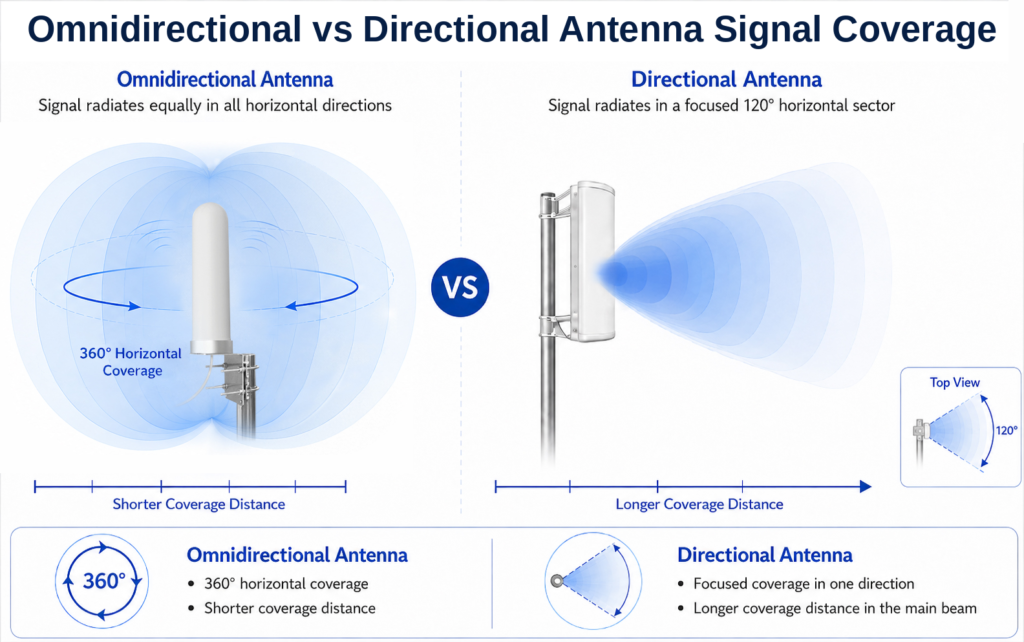
The key difference is the radiation pattern.
An omnidirectional antenna provides broad coverage around the antenna. It is a good choice when devices are located in different directions or when the device may move.
A directional antenna provides focused coverage. It is a better choice when the target receiver or coverage area is in a known direction.
Antenna gain is also related to this difference. Directional antennas often have higher gain because they focus energy into a smaller area. Omnidirectional antennas usually provide wider coverage but may have lower focused gain.
How to Choose the Right Antenna Type
When choosing between an omnidirectional antenna and a directional antenna, consider:
- Do you need wide coverage or focused coverage?
- Is the receiving device fixed or moving?
- Is the installation indoor or outdoor?
- What communication distance is required?
- Are there walls, buildings, or metal structures nearby?
- Is the application point-to-point or multipoint?
- What antenna gain and radiation pattern are required?
For general IoT communication, routers, gateways, and mobile devices, omnidirectional antennas are often suitable. For long-distance links, outdoor base stations, or targeted coverage, directional antennas may be better.
Common Mistakes in Antenna Selection
One common mistake is choosing a high-gain directional antenna when the device actually needs wide coverage. This can create strong signal in one direction but weak coverage elsewhere.
Another mistake is using an omnidirectional antenna for a long-distance fixed link where a directional antenna would provide better signal strength.
The best antenna is not always the highest gain antenna. It is the antenna that matches the coverage requirement, frequency band, installation environment, and device structure.
When Custom Antenna Design Helps
Custom antenna design can help when the required coverage pattern, gain, size, installation method, or frequency band cannot be achieved with a standard antenna.
A custom antenna solution may be needed when:
- The device requires a specific radiation pattern
- The antenna must fit a limited installation space
- Standard antennas provide poor coverage after installation
- The product needs outdoor or industrial durability
- The application requires point-to-point or area coverage
- Gain, direction, size, and structure must be balanced
By selecting the right radiation pattern early, engineers can improve signal coverage and reduce wireless performance problems.
FAQ
What is the difference between omnidirectional and directional antennas?
An omnidirectional antenna provides broad coverage around the antenna, while a directional antenna focuses signal in a specific direction.
Is a directional antenna better than an omnidirectional antenna?
Not always. Directional antennas are better for focused coverage, while omnidirectional antennas are better for wide-area coverage.
Which antenna is better for IoT devices?
Many IoT devices use omnidirectional antennas, but the best choice depends on device location, coverage requirement, and installation environment.
Which antenna is better for long-distance communication?
Directional antennas are often better for long-distance fixed links because they focus signal energy toward the target direction.
Conclusion
Omnidirectional and directional antennas serve different wireless coverage needs. Omnidirectional antennas are suitable for wide coverage, while directional antennas are better for focused or long-distance communication.
If your wireless device requires a specific radiation pattern, gain, frequency band, size, or installation method, our RF engineering team can help develop a custom antenna solution from design to production.