
Saudi Arabia has one of the most developed mobile markets in the region, but strong national cellular infrastructure does not mean every building, farm, industrial site, desert facility, or remote compound receives equally strong indoor signal.
For many fixed installations, the problem is not that cellular service is completely unavailable.
The problem is that the useful base station may be several kilometers away, the signal may arrive from one specific direction, or the building itself may significantly reduce signal penetration.
This is where a parabolic antenna in Saudi Arabia can become useful.
A high-gain parabolic antenna is designed to concentrate RF energy toward a relatively narrow direction. When a suitable 4G or 5G base-station sector has already been identified, the antenna can be mounted outdoors and aimed toward that serving direction.
A typical system may look like:
Cellular Tower → Outdoor Parabolic Antenna → 4G/5G CPE or Router → Ethernet → Indoor WiFi / Local Network
This architecture is especially relevant when the cellular signal outside the building is noticeably better than the signal available inside.
Saudi Arabia Does Not Have One Single “Weak Signal” Problem
It is tempting to say that Saudi Arabia uses parabolic antennas simply because the country is large and open.
That is only part of the picture.
Saudi projects can include very different RF environments:
- villas and residential compounds;
- traditional thick-walled buildings;
- modern glass and metal buildings;
- farms;
- desert camps;
- industrial facilities;
- warehouses;
- mining and energy sites;
- remote security locations;
- construction projects.
Each environment creates a different propagation problem.
A directional antenna is useful only when the network geometry supports directional communication.
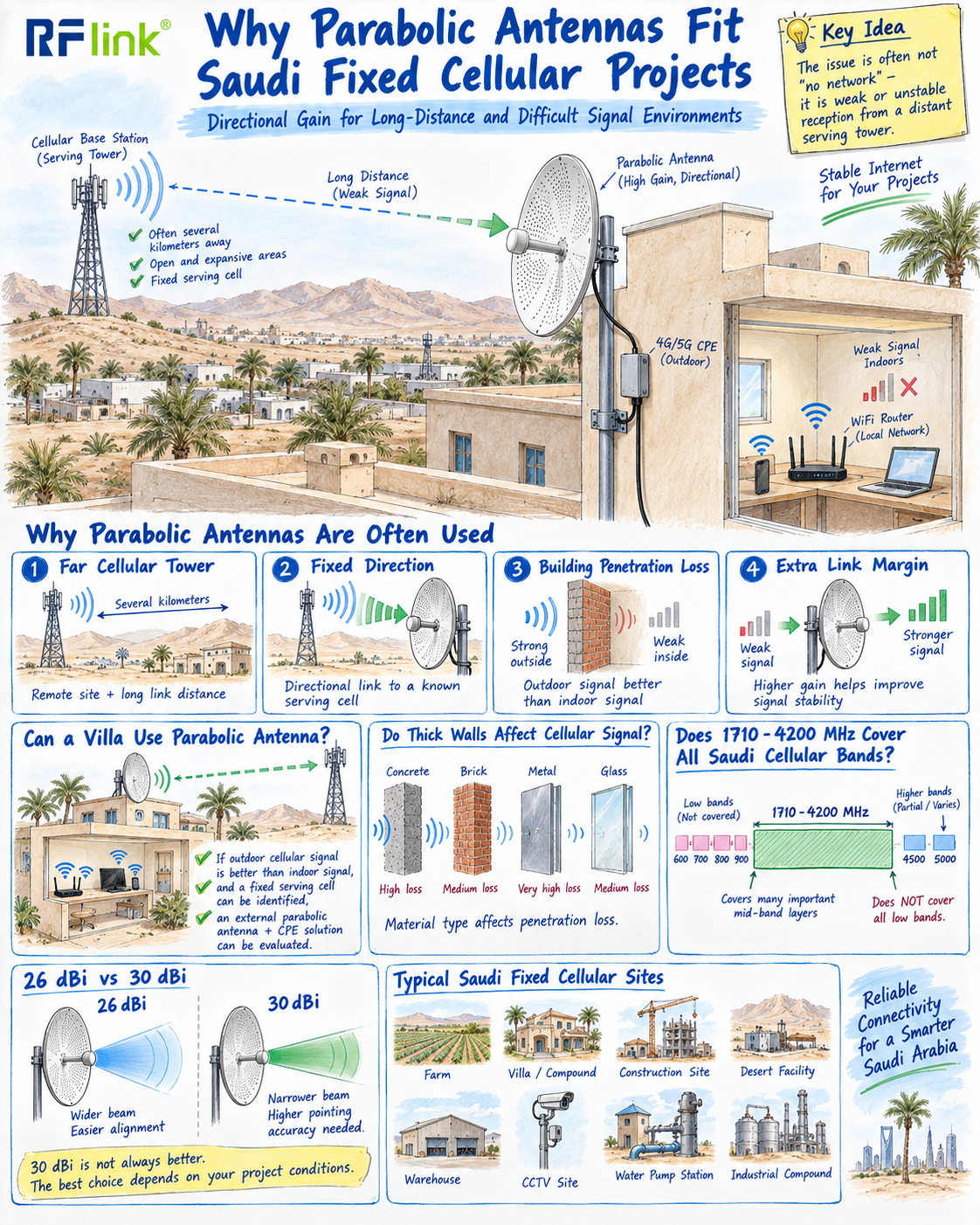
Thick Walls and Modern Building Materials Can Reduce Indoor Cellular Signal
Saudi Arabia’s hot climate makes thermal performance an important part of building design. In practice, the built environment can include masonry, reinforced concrete, thermal insulation systems, coated glass, metal structures, and other materials that affect RF penetration.
This is not merely theoretical.
A recent GSMA case study involving Zain KSA specifically highlighted indoor coverage challenges created by Saudi architecture. It reported examples of traditional walls reaching approximately 50 cm in thickness and noted significant additional signal loss. The same case also discussed modern glass and metal buildings and triple-glazed glass used for heat management as additional sources of indoor cellular attenuation.
This does not mean every Saudi building has 50 cm walls.
The important engineering lesson is that building materials matter.
If a router is placed deep inside a concrete or highly insulated building, increasing the router’s internal antenna gain may not solve the real problem.
A more effective architecture may be to move the cellular antenna outside the high-loss building envelope.
Why an Outdoor Parabolic Antenna Can Help
Imagine a villa, warehouse, farm office, or remote compound where:
- the smartphone receives weak signal indoors;
- the roof or exterior of the building has noticeably stronger cellular signal;
- one serving tower or sector can be identified;
- the router remains in a fixed location.
Instead of requiring the cellular signal to pass through several walls before reaching the modem, the system can use an outdoor directional antenna.
The parabolic antenna receives the signal outdoors, where the propagation path is often better.
A coaxial connection then carries the RF signal to a compatible CPE or router, or the CPE itself can be installed close to the antenna and connected to the indoor network through Ethernet.
The indoor users then access the network through WiFi or Ethernet.
The dish is therefore not “boosting WiFi through the wall.”
It is improving the cellular WAN connection before the local WiFi network begins.
Open Terrain Can Favor Directional Cellular Links
Many Saudi projects are deployed outside dense urban centers.
Examples include:
- farms;
- highways;
- solar installations;
- oil and gas facilities;
- remote warehouses;
- industrial compounds;
- construction camps;
- pumping stations;
- monitoring sites.
In relatively open terrain, the useful serving-cell direction can sometimes be identified clearly.
When the terminal is fixed and the tower direction is stable, a high-gain directional antenna can concentrate reception and transmission toward that sector.
This is fundamentally different from a vehicle or moving device.
A moving device may need signals from changing directions and is often better suited to an omnidirectional architecture.
RFLink’s omnidirectional vs directional antenna guide explains this distinction in more detail.
Why Not Simply Use a High-Gain Omnidirectional Antenna?
Because high gain and directional gain are not the same thing.
An omnidirectional antenna distributes RF energy around the antenna in a broad horizontal pattern.
A parabolic reflector concentrates energy much more narrowly.
If the serving base station is in one known direction, there is little benefit in receiving equally from every direction.
A directional antenna can instead focus its useful pattern toward the selected tower.
It may also reduce sensitivity to some signals arriving from unwanted directions.
However, this advantage comes with a cost:
the antenna must be accurately aligned.
If the user does not know which serving cell is providing the best network, installing the largest available dish is not a good first step.
Saudi Cellular Networks Use Multiple Frequency Layers
Another important point for Saudi buyers is that there is no single “Saudi 4G frequency.”
According to Saudi Arabia’s Communications, Space and Technology Commission, mobile spectrum currently includes 700, 800, 900, 1800, 2100, 2300, 2600 and 3500–3800 MHz, with additional 600, 700 and 3800–4000 MHz spectrum awarded in the 2024 auction.
That means antenna selection should always start with the actual serving frequency.
RFLink’s current wideband parabolic platform covers 1710–4200 MHz.
This makes it relevant to several Saudi mid-band mobile layers, including frequencies around 1800, 2100, 2300, 2600 and the 3.5–4.0 GHz range.
However, it does not cover 600, 700, 800 or 900 MHz.
That limitation should be treated as a useful filtering rule rather than hidden in the specification.
If the remote site depends mainly on a low-band 700 or 800 MHz coverage layer, another antenna solution is required.
1710–4200 MHz Is Useful Because One Site May See More Than One Mid-Band Layer
A narrow single-band antenna can work well when the network configuration will never change.
But system integrators frequently prefer wider frequency flexibility.
A Saudi CPE project may use one operator today and another operator later. A router may support several LTE and NR bands. Different locations in the same deployment may connect using different mid-band spectrum.
A 1710–4200 MHz antenna platform provides useful flexibility across a wide range of these mid-band systems.
RFLink currently offers a 600 mm 26 dBi 1710–4200 MHz parabolic antenna and a 900 mm 30 dBi 1710–4200 MHz parabolic antenna.
Both use dual-linear horizontal and vertical polarization for compatible dual-port and MIMO wireless systems.
600 mm or 900 mm for a Saudi Project?
The correct answer is not automatically “900 mm.”
The 600 mm model provides up to 26 dBi gain.
The 900 mm model provides up to 30 dBi.
But the larger reflector also creates a narrower beam.
This means the 900 mm model offers additional directional link gain while requiring more accurate alignment and a stable mounting structure.
A 600 mm antenna may be appropriate when:
- the cellular link already has reasonable signal;
- installation space matters;
- transportation matters;
- a slightly broader alignment tolerance is useful.
A 900 mm antenna may be appropriate when:
- the link is more difficult;
- additional link margin is required;
- the tower direction is well known;
- the mast can hold the antenna accurately.
RFLink’s antenna gain guide explains why a larger dBi value should always be considered together with radiation pattern and installation geometry.
Outdoor Installation Is More Than Putting the Dish on the Roof
A rooftop is not automatically the best antenna location.
The installer should evaluate:
- clear direction toward the serving cell;
- roof parapets;
- neighboring buildings;
- metal water tanks;
- air-conditioning equipment;
- solar panels;
- tower structures;
- nearby electrical equipment;
- mast stability;
- RF cable length.
A dish installed behind a concrete parapet or large metal structure may perform very differently from the same antenna only a few meters away in a clear position.
Keep RF Cable Loss Under Control
One common installation mistake is mounting the antenna in a very good high position but leaving the modem far away.
This creates a long RF feeder.
At 1800–4000 MHz, cable attenuation can become meaningful.
A system designer should therefore compare:
Dish → long coaxial cable → indoor router
with:
Dish → short RF cable → outdoor/nearby CPE → Ethernet to indoor network
Ethernet is often easier to extend over distance than an RF signal at cellular mid-band frequencies.
The exact design depends on the equipment and installation, but feeder loss should always be included in the link budget.
The Dish Does Not Replace Indoor WiFi
This is especially important for Saudi residential and commercial projects.
Once the cellular WAN connection becomes stable, indoor coverage must still be designed.
A large villa, office, compound, warehouse, or resort may need multiple WiFi APs.
A strong cellular signal at the router does not automatically mean every room has good WiFi.
The complete architecture is:
Outdoor cellular link → Router → LAN → WiFi coverage
not:
Parabolic antenna → magically stronger WiFi everywhere
Which Saudi Applications Are Good Candidates?
Good candidates include fixed installations where the cellular network is available but difficult to receive reliably indoors or at the equipment location.
Examples include:
- villas outside dense urban coverage;
- farms;
- remote compounds;
- warehouses;
- industrial facilities;
- construction camps;
- solar farms;
- CCTV stations;
- pumping facilities;
- temporary infrastructure;
- mining and energy sites.
In each case, the best antenna should be selected after confirming the real cellular network.
What Information Should a Saudi Customer Provide?
A useful project inquiry should include:
- installation city or region;
- mobile operator;
- router/CPE model;
- detected LTE/5G bands;
- outdoor RSRP/RSRQ/SINR if available;
- indoor measurements;
- approximate serving-tower direction;
- cable length;
- mounting height;
- preferred reflector size;
- MIMO port configuration.
This information allows the antenna supplier to give a much more meaningful recommendation.
FAQ
Why are parabolic antennas popular for fixed cellular links in Saudi Arabia?
Saudi projects can combine large outdoor areas, remote infrastructure and buildings that significantly attenuate cellular signals. When the serving tower is in a known direction, a high-gain directional antenna can provide additional link margin.
Can a parabolic antenna solve weak signal inside a Saudi villa?
It may help when outdoor cellular signal is significantly better than indoor signal. The antenna is normally installed outside and connected to a compatible CPE/router.
Are thick Saudi walls really a cellular problem?
Some Saudi buildings use thick masonry, concrete, insulated structures or specialized glazing that can significantly reduce indoor cellular penetration. The exact loss depends on the specific building.
Does RFLink’s 1710–4200 MHz antenna cover every Saudi cellular band?
No. It covers several important mid-band layers but does not cover Saudi mobile spectrum below 1710 MHz, such as 600/700/800/900 MHz.
Is a 30 dBi antenna always better than 26 dBi?
No. Higher gain comes with a narrower beam and greater alignment sensitivity.
Conclusion
The reason parabolic antennas are useful in Saudi Arabia is not simply that the country is large.
Their value comes from a combination of fixed cellular terminals, known serving-tower directions, challenging indoor penetration and remote-site connectivity requirements.
When a good cellular signal exists outdoors but the indoor environment weakens it, an outdoor directional antenna can move the RF receiving point outside the building envelope.
When a remote Saudi site can identify a useful tower in one direction, a high-gain dish can focus the radio link toward that sector.
But frequency must always come first.
RFLink’s current 1710–4200 MHz parabolic platform is well matched to several Saudi mid-band mobile layers, while lower-frequency Saudi networks require a different antenna.
For Saudi projects requiring different frequencies, connectors, reflector structures or mounting designs, RFLink’s custom antenna solutions can support project-specific development.