
In smart agriculture, the most valuable data often comes in small packets: soil moisture, soil temperature, EC, pH, NPK, rainfall, wind speed, valve status, pump status, battery level, livestock location, and grain storage temperature. These data points do not require high bandwidth, but they do require long-distance, low-power, and stable wireless transmission. This is why LoRaWAN has become a practical communication choice for many farms, greenhouses, irrigation systems, and rural IoT projects.
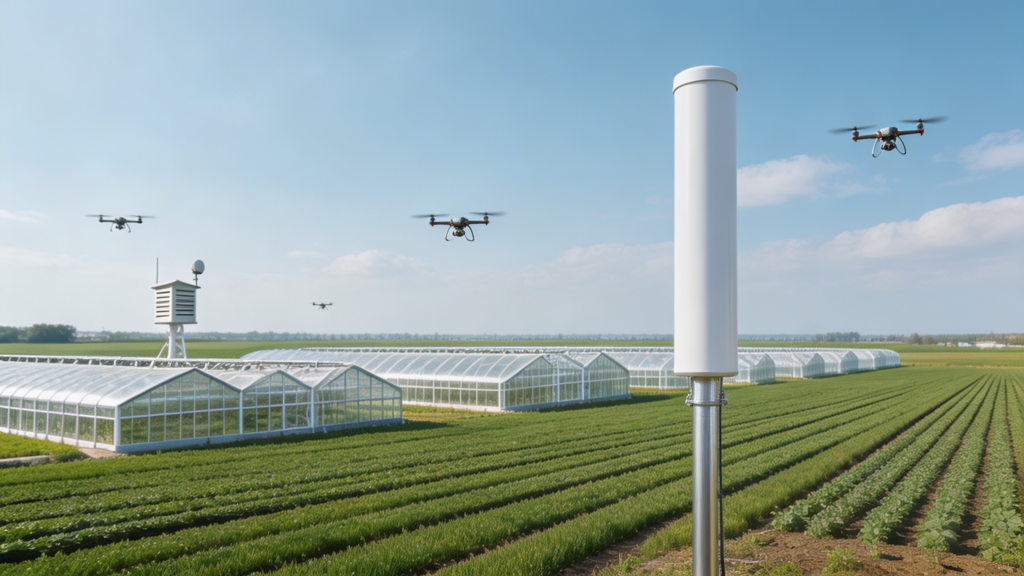
A typical LoRaWAN agriculture network connects field nodes to a gateway, and then the gateway sends data to the cloud. In this structure, the gateway antenna is not just an accessory. It directly affects how many sensors can be reached, how stable the network is, and how much maintenance the system may need after installation.
For outdoor LoRaWAN gateways, a fiberglass LoRa antenna is often a reliable choice. It can be installed on rooftops, poles, water towers, farm offices, greenhouse roofs, or dedicated masts to improve line-of-sight coverage. Compared with small indoor antennas or short rubber antennas, a fiberglass omnidirectional antenna is better suited for wide-area outdoor deployment, long-term weather exposure, and stable signal reception from distributed sensor nodes.
For ordinary farmland, a 3–6dBi fiberglass omnidirectional antenna is often suitable for balanced coverage. For large flat farms, a 5–8dBi fiberglass antenna may help extend communication distance. However, higher gain is not always better. High-gain omnidirectional antennas usually have a narrower vertical beam, which may create blind spots near the gateway or perform poorly in uneven terrain. The right antenna should be selected based on farm size, terrain, node distribution, gateway height, cable loss, and local frequency requirements.
RFLINK supports smart agriculture projects with LoRa antenna solutions for 868MHz, 915MHz, and other sub-GHz applications. From antenna gain and connector type to cable length, waterproof structure, and mounting method, every detail can influence real field performance. For customers whose standard antennas cannot meet their installation or coverage requirements, a customized antenna solution can make the network more reliable from the beginning.
In a smart farm, every sensor reading supports a decision: when to irrigate, when to ventilate, when to inspect a pump, or when to protect stored grain. A well-designed fiberglass LoRa antenna helps those decisions reach the cloud quietly, continuously, and over long distances.