
Frequency band in antenna design refers to the range of frequencies that an antenna is designed to transmit or receive effectively. Every wireless system works within a specific frequency range, and the antenna must be designed or selected to match that operating frequency.
For example, a wireless device may use 433MHz, 868MHz, 915MHz, 2.4GHz, GNSS, WiFi, LoRa, LTE, or other frequency bands. If the antenna does not match the required frequency band, the device may have weak signal, short communication range, or unstable wireless performance.
This is why frequency band is one of the first questions engineers consider during antenna design and antenna selection.
Why Frequency Band Matters
An antenna is not a universal component that works equally well at all frequencies. Its physical size, structure, material, matching circuit, and installation position are closely related to the target frequency band.
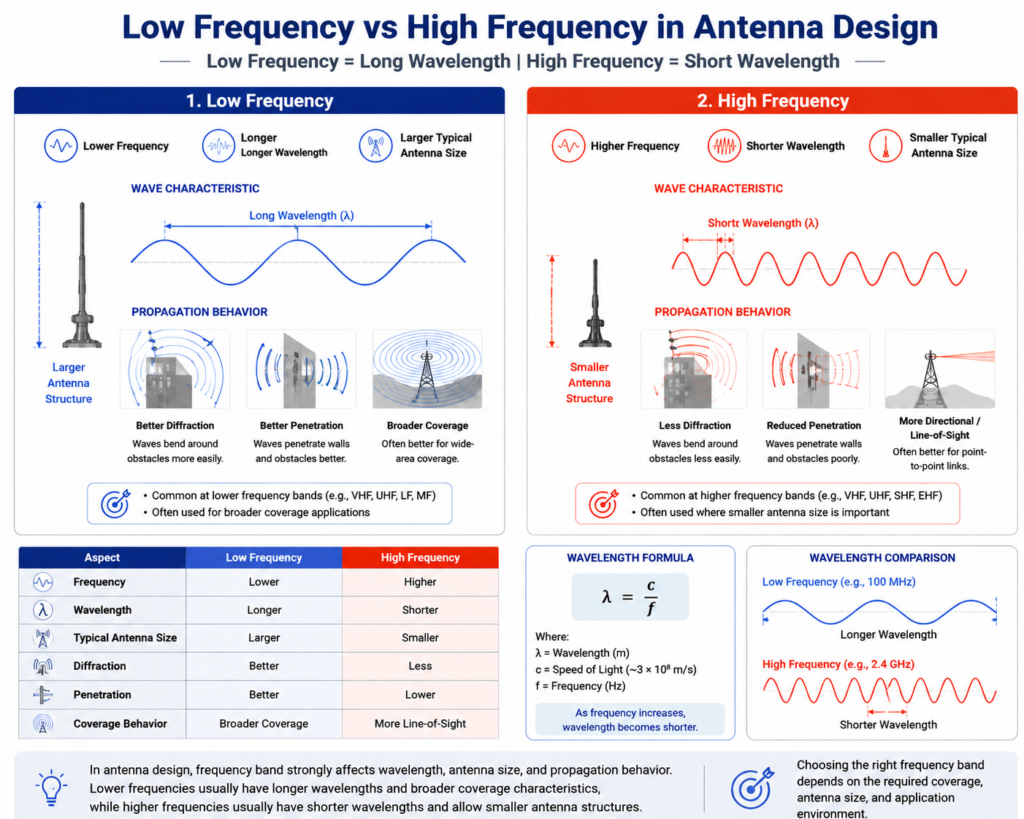
Lower frequencies usually have longer wavelengths, which often require larger antenna structures. Higher frequencies have shorter wavelengths, which can allow smaller antennas, but they may be more sensitive to obstacles, device layout, and installation conditions.
For this reason, a 433MHz antenna is usually larger than a 2.4GHz antenna. A GNSS antenna is designed for satellite positioning bands, while a WiFi antenna is designed for wireless network communication. Each application needs the right antenna frequency band.
Common Antenna Frequency Bands
Different wireless applications use different frequency bands. Some common examples include:
- 433MHz: remote controls, smart meters, industrial wireless devices
- 868MHz / 915MHz: LoRa, IoT, smart agriculture, remote monitoring
- 1.575GHz: GPS / GNSS positioning applications
- 2.4GHz: WiFi, Bluetooth, Zigbee, IoT devices
- 5GHz / 6GHz: WiFi and high-speed wireless communication
- LTE / 4G / 5G bands: cellular communication modules and industrial gateways
Choosing the correct frequency band is not only about matching a number. Engineers also need to consider antenna bandwidth, gain, efficiency, VSWR, device structure, and the real installation environment.
Frequency Band and Antenna Size
Antenna size is strongly related to wavelength. In general, lower frequency antennas require more physical length to radiate efficiently. This is one reason why low-frequency antennas can be difficult to integrate into compact devices.
For embedded antennas such as PCB antennas and FPC antennas, the available space inside the product can limit the antenna performance. If the antenna space is too small for the target frequency band, tuning and optimization become more important.
This is common in IoT sensors, trackers, handheld devices, smart meters, and compact wireless modules.
Single-Band, Dual-Band, and Multiband Antennas
Some devices only need one frequency band, while others require multiple bands.
A single-band antenna is optimized for one main frequency range. A dual-band antenna can support two frequency bands, such as 2.4GHz and 5GHz WiFi. A multiband antenna is used when a device needs to support several wireless standards, such as LTE, GNSS, WiFi, or Bluetooth.
Multiband antenna design is usually more complex because the antenna must maintain acceptable performance across different frequency ranges. In compact devices, this can require careful layout, matching, and testing.
How to Choose the Right Antenna Frequency Band
When choosing an antenna frequency band, consider:
- What wireless technology does the device use?
- What frequency band does the RF module require?
- Is the device used indoors, outdoors, or in a mobile environment?
- How much space is available for the antenna?
- Does the product need single-band or multiband operation?
- Are there metal parts, batteries, or screens near the antenna?
- What range and signal stability are required?
The antenna must match both the RF module and the final product structure. A standard antenna may work well in free space but perform differently after installation.
tuning problems and improve wireless reliability.
FAQ
What does frequency band mean in antenna design?
It means the range of frequencies that an antenna is designed to transmit or receive effectively.
Can one antenna work for all frequency bands?
No. Antennas are designed for specific frequency ranges. One antenna cannot perform equally well across all bands.
Why are lower frequency antennas usually larger?
Lower frequencies have longer wavelengths, which often require larger antenna structures for efficient radiation.
When do I need a multiband antenna?
You may need a multiband antenna when your device supports multiple wireless systems, such as LTE, GNSS, WiFi, Bluetooth, or LoRa.
Conclusion
Frequency band is one of the most important factors in antenna design. It affects antenna size, structure, performance, bandwidth, and integration difficulty.
If your wireless device has special requirements for frequency band, size, gain, installation space, or multiband performance, our RF engineering team can help develop a custom antenna solution from design to production.

Pingback: How to Choose a GNSS Antenna for GPS Tracking Devices - RF Link