
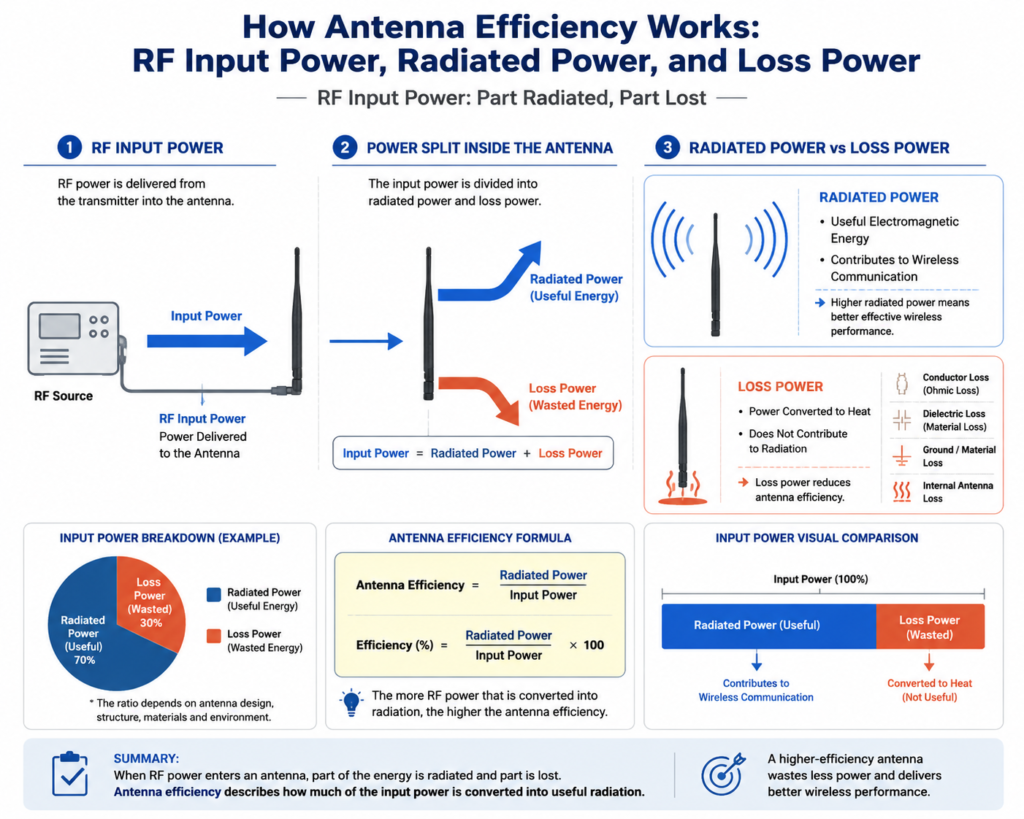
Antenna efficiency describes how well an antenna converts input RF energy into radiated electromagnetic energy. In simple terms, it tells us how much of the signal power actually becomes useful wireless signal.
A high-efficiency antenna radiates more of the available energy into the air. A low-efficiency antenna loses more energy as heat, mismatch loss, material loss, or absorption by nearby components.
Antenna efficiency is one of the most important factors in RF antenna performance, especially for compact wireless devices, embedded antennas, IoT products, and battery-powered equipment.
Why Antenna Efficiency Matters
Antenna efficiency matters because it directly affects real-world wireless performance. Even if an antenna has good gain or acceptable VSWR, poor efficiency can still result in weak signal, short communication distance, and unstable connection.
For example, a small embedded antenna may look suitable on paper, but if it is placed too close to metal parts, batteries, screens, or a poorly designed ground plane, much of the RF energy may be lost before it can radiate effectively.
This is why antenna efficiency should be evaluated together with gain, VSWR, impedance matching, and installation conditions.
Radiation Efficiency and Total Efficiency
There are two common ways to discuss antenna efficiency: radiation efficiency and total efficiency.
Radiation Efficiency
Radiation efficiency describes how much accepted power is actually radiated by the antenna. Loss can come from antenna materials, conductors, dielectric materials, and nearby structures.
Antenna materials, size, structure, and surrounding environment can all affect radiation efficiency.
Total Efficiency
Total efficiency includes both radiation efficiency and mismatch loss. This means it considers not only how well the antenna radiates energy, but also how much energy is lost because of impedance mismatch.
In practical antenna testing, total efficiency is often very useful because it gives a more complete view of antenna performance in the final device.
What Causes Low Antenna Efficiency?
Low antenna efficiency can be caused by many factors, including:
- Antenna size is too small for the frequency band
- Poor impedance matching
- High VSWR in the target frequency range
- Antenna placed too close to metal parts
- Insufficient ground plane
- Lossy plastic or device materials
- Poor cable or connector quality
- Compact product structure limiting radiation space
- Battery, display, or PCB components blocking the antenna
These issues are especially common in embedded antenna design. PCB antennas and FPC antennas often require careful placement and tuning to achieve stable efficiency.
Is Higher Gain the Same as Higher Efficiency?
No. Antenna gain and antenna efficiency are related, but they are not the same.
Antenna gain describes how the antenna directs radiated energy in space. Antenna efficiency describes how much input energy is successfully radiated. An antenna may have a directional radiation pattern but still lose energy due to poor materials, mismatch, or installation problems.
This is why engineers should not judge antenna performance based on gain alone. A complete evaluation should include gain, efficiency, VSWR, radiation pattern, and real communication testing.
How to Improve Antenna Efficiency
Antenna efficiency can often be improved through better design and integration. Common methods include:
- Choosing the right antenna type for the frequency band
- Keeping enough clearance around the antenna
- Avoiding nearby metal components
- Optimizing the PCB ground plane
- Improving impedance matching
- Adjusting the antenna position inside the device
- Using proper cable and connector design
- Testing performance after final assembly
For compact wireless devices, antenna tuning is often needed after the antenna is integrated into the product. This helps improve efficiency under real installation conditions.
When Custom Antenna Design Helps
Custom antenna design can help when standard antennas cannot provide the required efficiency, size, frequency coverage, or installation performance.
A custom antenna solution may be needed when:
- The device has limited internal space
- The antenna must be embedded inside the housing
- Standard antennas show low efficiency after installation
- The product requires stable wireless range
- The device uses multiple frequency bands
- The final structure affects antenna radiation
By optimizing the antenna together with the device structure, engineers can improve real-world wireless performance and reduce production risk.
FAQ
What does antenna efficiency mean?
Antenna efficiency describes how much input RF energy is successfully radiated as wireless signal.
Why is antenna efficiency important?
It affects signal strength, communication distance, battery performance, and connection stability.
Is good VSWR enough for good antenna efficiency?
No. Good VSWR is important, but antenna efficiency can still be low if energy is lost due to materials, metal interference, or poor placement.
How can antenna efficiency be improved?
It can be improved through better antenna selection, impedance matching, placement, ground plane design, and antenna tuning.
Conclusion
Antenna efficiency is a key measurement of real RF antenna performance. It shows how effectively an antenna converts RF energy into usable wireless signal.
If your wireless device has special requirements for frequency, size, installation space, efficiency, or signal stability, our RF engineering team can help develop and optimize a custom antenna solution from design to production.