
VSWR stands for Voltage Standing Wave Ratio. It is an important measurement used to describe how well an antenna is matched to the transmission line and RF system. In antenna design, VSWR helps engineers understand how much signal energy is delivered to the antenna and how much is reflected back.
A lower VSWR usually means better impedance matching and less signal reflection, which helps improve antenna performance.
For wireless devices, antenna VSWR is an important factor because poor matching can reduce signal strength, lower efficiency, and affect communication stability.
Why VSWR Matters in Antenna Design
In most RF systems, the antenna, cable, connector, and circuit are designed around a specific impedance, commonly 50 ohms. When the antenna impedance matches the system impedance well, more signal power can be transferred to the antenna.
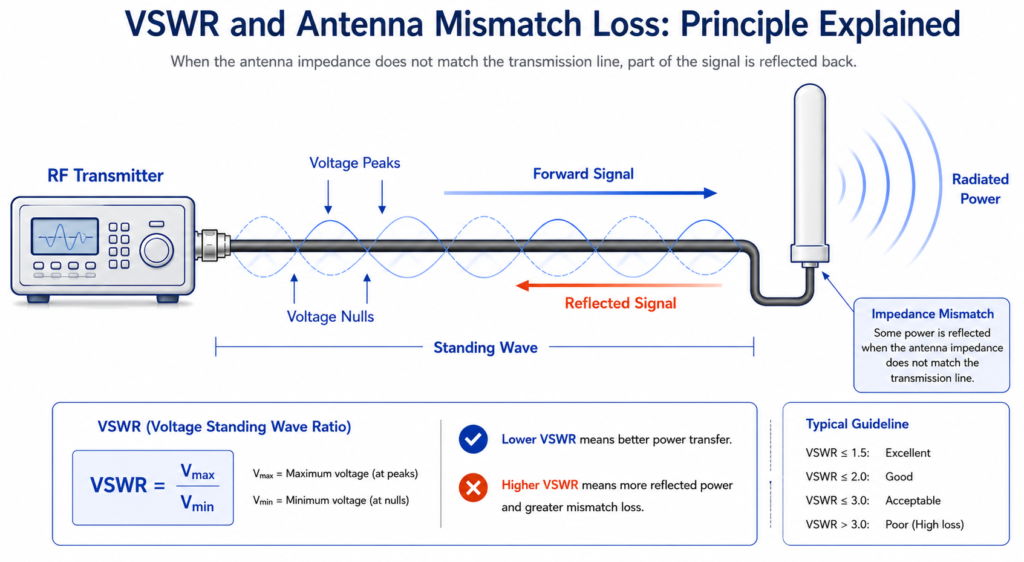
If the impedance is not properly matched, part of the signal power is reflected back instead of being radiated by the antenna. This reflected power can reduce antenna efficiency and may affect the performance of the wireless device.
This is why VSWR testing is often used during antenna selection, antenna tuning, and product development.
What Is a Good VSWR Value?
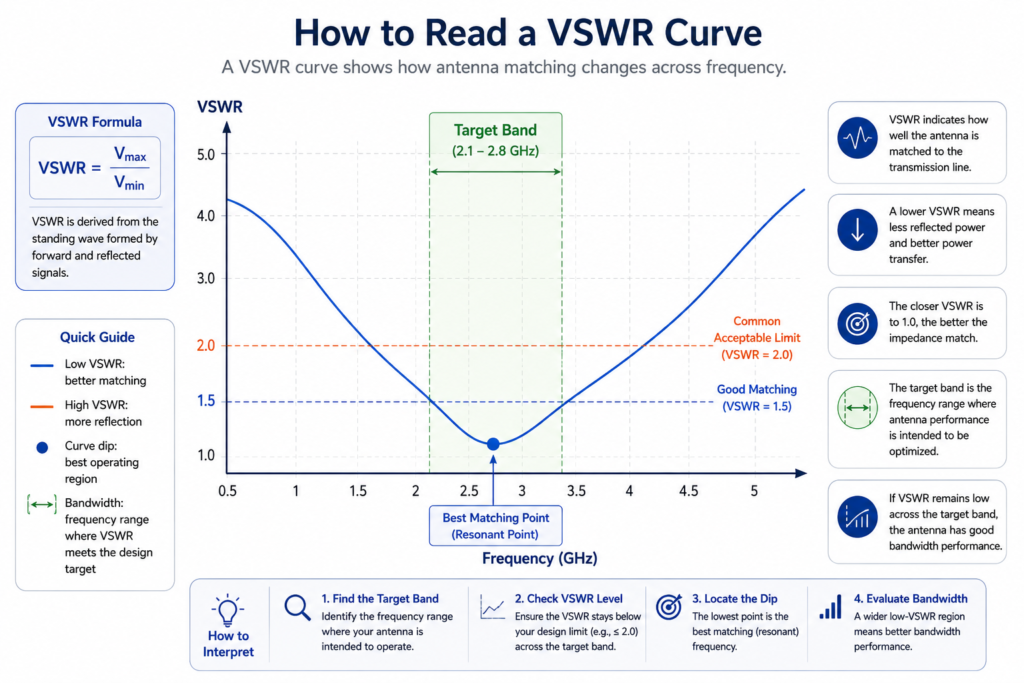
The ideal VSWR is 1:1, which means there is no signal reflection. In real applications, this is almost impossible to achieve perfectly.
In many wireless applications, a VSWR below 2.0:1 is generally considered acceptable. A lower value, such as 1.5:1 or better, usually indicates better impedance matching. However, the acceptable VSWR value depends on the application, frequency band, antenna type, and system requirements.
It is important to remember that VSWR is only one part of antenna performance. Gain, efficiency, radiation pattern, installation position, and real-world testing should also be considered.
VSWR and Signal Reflection
VSWR is closely related to signal reflection. When an antenna is poorly matched, part of the RF energy travels back toward the transmitter instead of being radiated into the air.
This can happen for several reasons:
- The antenna is not designed for the correct frequency band
- The antenna is installed too close to metal parts
- The device housing affects the antenna environment
- The PCB layout or ground plane is not suitable
- The cable or connector causes additional mismatch
- The antenna changes performance after final assembly
For embedded antennas, such as PCB antennas and FPC antennas, VSWR can change significantly after the antenna is installed inside the final product. This is why antenna tuning is often necessary.
VSWR, Impedance Matching, and Antenna Efficiency
VSWR is often used together with impedance matching and antenna efficiency. Good impedance matching helps reduce reflected power. Better matching usually allows more energy to be radiated by the antenna.
However, a good VSWR does not always mean the antenna will perform perfectly. An antenna can have acceptable VSWR but still have low efficiency if it is blocked by metal, placed in a poor position, or affected by the device structure.
This is why engineers should not judge antenna performance by VSWR alone. A complete antenna evaluation should include VSWR, gain, efficiency, radiation pattern, and actual communication testing.
How Custom Antenna Tuning Improves VSWR
Custom antenna tuning helps adjust antenna performance after it is integrated into the device. During tuning, engineers may adjust the antenna structure, matching circuit, cable length, installation position, or ground clearance.
This process is especially useful when:
- The device has limited internal space
- The antenna must work inside a plastic or metal housing
- The product uses multiple frequency bands
- The antenna performance changes after assembly
- Standard antennas cannot meet the required VSWR or efficiency
For products that require stable wireless performance before mass production, antenna testing and tuning can reduce development risk.
When Do You Need VSWR Testing?
VSWR testing is useful during several stages of product development:
- When selecting a standard antenna
- When designing a custom antenna
- When integrating an embedded antenna into a device
- When checking performance after assembly
- Before wireless certification or mass production
VSWR testing helps confirm whether the antenna is properly matched to the device and whether further tuning is needed.
FAQ
What does VSWR mean?
VSWR means Voltage Standing Wave Ratio. It measures how well an antenna is matched to the RF system.
Is lower VSWR better?
In general, yes. A lower VSWR usually means less signal reflection and better impedance matching.
What is a good VSWR for an antenna?
In many wireless applications, VSWR below 2.0:1 is considered acceptable, but the best target depends on the product and application.
Can good VSWR guarantee good antenna performance?
No. VSWR is important, but gain, efficiency, radiation pattern, installation position, and real-world testing are also necessary.
Conclusion
VSWR is one of the key measurements in antenna design and testing. It helps show whether an antenna is properly matched to the RF system and whether signal reflection may affect performance.
If your wireless device has special requirements for frequency, size, installation space, gain, or VSWR, our RF engineering team can help develop and tune a custom antenna solution from design to production.