
For a cellular antenna project in Saudi Arabia, frequency coverage is one of the first specifications that should be checked.
However, this does not necessarily mean a system integrator needs a separate high-gain antenna for every individual cellular band.
Saudi Arabia uses multiple mobile frequency layers, and a large portion of the country’s important mid-band spectrum falls inside one continuous range: 1710–4200 MHz.
This makes a wideband 1710–4200 MHz parabolic antenna for Saudi Arabia particularly useful for fixed 4G LTE, 5G, FWA, remote CPE and industrial cellular applications.
According to the Communications, Space and Technology Commission (CST), Saudi mobile spectrum includes 700, 800, 900, 1800, 2100, 2300, 2600 and 3500–3800 MHz. The Q4 2024 spectrum auction additionally awarded spectrum in 600 MHz, 700 MHz and 3800–4000 MHz.
Looking at these published spectrum ranges, RFLink’s 1710–4200 MHz parabolic antenna platform fully covers:
- 1800 MHz;
- 2100 MHz;
- 2300 MHz;
- 2600 MHz;
- 3500–3800 MHz;
- 3800–4000 MHz.
In other words, six of the ten major Saudi mobile spectrum ranges identified in the current CST information fall entirely inside the RFLink antenna’s 1710–4200 MHz operating range.
More importantly for fixed cellular projects, every CST-listed Saudi mobile spectrum range from 1800 MHz through 4000 MHz sits inside the antenna’s specified frequency coverage.
That gives Saudi system integrators a very broad platform for many of the country’s LTE, 5G mid-band and fixed wireless applications.
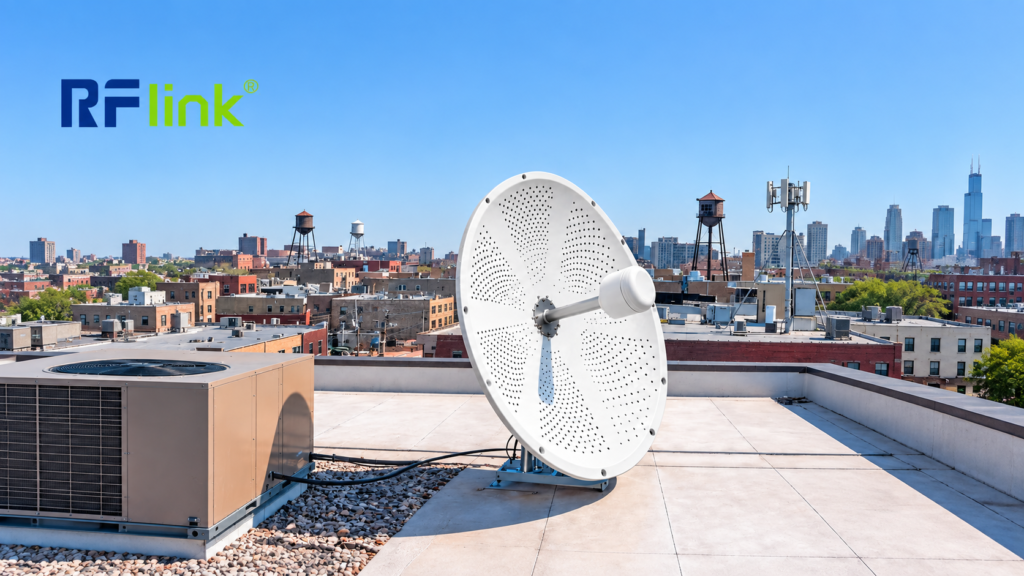
Saudi Arabia Uses Multiple Cellular Frequency Layers
There is no single “Saudi 4G frequency.”
There is also no single “Saudi 5G frequency.”
Modern mobile networks are built using several spectrum layers, each of which can play a different role in coverage, capacity and network evolution.
Saudi Arabia’s current spectrum structure reflects this.
At lower frequencies, the Kingdom has spectrum around 600, 700, 800 and 900 MHz.
At mid-band frequencies, the mobile spectrum structure extends across 1800, 2100, 2300, 2600, 3500–3800 and 3800–4000 MHz.
For RF antenna selection, this division is useful.
A single antenna does not necessarily need to cover everything from 600 MHz to 4 GHz to be commercially valuable.
Instead, an antenna can be optimized around the frequency range most relevant to a particular type of deployment.
For RFLink’s high-gain directional parabolic platform, that range is 1710–4200 MHz.
How Much of Saudi Mobile Spectrum Does 1710–4200 MHz Cover?
The easiest way to understand the value is to compare the ranges directly.
| Saudi mobile spectrum range | Covered by RFLink 1710–4200 MHz? | Relevance |
|---|---|---|
| 600 MHz | No | Low-band coverage layer |
| 700 MHz | No | Low-band coverage layer |
| 800 MHz | No | Low-band coverage layer |
| 900 MHz | No | Low-band coverage layer |
| 1800 MHz | Yes | Major cellular mid-band |
| 2100 MHz | Yes | Major cellular mid-band |
| 2300 MHz | Yes | Broadband mobile spectrum |
| 2600 MHz | Yes | Broadband mobile spectrum |
| 3500–3800 MHz | Yes | Important 5G mid-band spectrum |
| 3800–4000 MHz | Yes | Newly awarded Saudi mid-band spectrum |
Based on CST’s currently published mobile spectrum information, this means six out of ten major listed Saudi frequency ranges fall completely inside 1710–4200 MHz.
That is an important distinction.
RFLink is not claiming that 1710–4200 MHz covers every cellular frequency used in Saudi Arabia.
It does not.
What it does cover is the majority of the listed frequency ranges and the complete group of currently listed mobile spectrum ranges from 1800 MHz upward through 4000 MHz.
For a high-gain fixed directional antenna, that is an especially useful spectrum window.
Why 1710–4200 MHz Is Well Suited to High-Gain Fixed Cellular Links
Low-frequency spectrum is extremely valuable for broad-area coverage and building penetration.
But fixed directional cellular installations have different requirements from ordinary smartphones.
A fixed CPE can be:
- installed outdoors;
- mounted at a higher position;
- aimed toward a known serving sector;
- connected to a high-gain directional antenna;
- professionally aligned using network measurements.
This means a fixed system can take advantage of mid-band spectrum in ways that a handheld device inside a building cannot.
Mid-band cellular networks can provide important capacity and bandwidth, while a directional antenna helps compensate for difficult path conditions by concentrating RF energy toward the useful serving direction.
This combination is highly relevant to Saudi applications such as:
- remote broadband;
- FWA;
- farms;
- villas and compounds;
- industrial sites;
- construction camps;
- CCTV systems;
- solar farms;
- mining projects;
- oil and gas infrastructure;
- warehouses;
- remote monitoring stations.
One Antenna Platform for Multiple Saudi Cellular Bands
This is the main commercial advantage of a wideband 1710–4200 MHz design.
A narrow single-band antenna may work very well for one specific network.
But a Saudi telecom integrator may manage many projects.
One site may operate primarily around 1800 MHz.
Another may use 2100 MHz.
Another may connect using 2300 or 2600 MHz.
A fixed wireless or 5G project may use spectrum around 3.5 GHz.
Another project may operate in the newly available 3.8–4.0 GHz range.
All of those frequency areas fit inside the same RFLink 1710–4200 MHz antenna platform.
This can simplify:
- antenna sourcing;
- inventory;
- project planning;
- CPE integration;
- field replacement;
- distributor stock;
- multi-site deployment.
Instead of preparing a completely different physical antenna design for every mid-band project, an integrator can use one wideband high-gain platform across many Saudi applications.
Why This Matters for Saudi Distributors and System Integrators
Consider a distributor supplying antennas to multiple Saudi customers.
Customer A needs a fixed 1800 MHz cellular connection.
Customer B requires 2100 MHz.
Customer C has a 2600 MHz CPE.
Customer D is building a 3.5 GHz fixed wireless installation.
Customer E needs equipment supporting a network around 3.8–4.0 GHz.
If each requirement needs a separate narrow-band dish, product inventory quickly becomes complicated.
A 1710–4200 MHz wideband platform can support all of these frequency areas, provided the radio equipment and network configuration are compatible.
This gives distributors a broader product application range from one antenna family.
It is particularly useful for OEMs, CPE vendors and project integrators who may not know the final operating band until the network survey or deployment location is confirmed.
1800 MHz: An Important Part of the Coverage Range
The RFLink platform begins at 1710 MHz, which means the 1800 MHz cellular region falls comfortably inside the operating range.
This is important because 1800 MHz has been a major mobile communications band internationally and remains part of Saudi Arabia’s published mobile spectrum structure.
For fixed installations where a useful serving cell operates in this region, the same parabolic antenna platform can be used without changing to a separate low-frequency antenna design.
2100 MHz, 2300 MHz and 2600 MHz
The antenna also continues through the 2100, 2300 and 2600 MHz cellular regions.
These frequencies are particularly useful from a product-planning perspective because they sit comfortably inside the center portion of the antenna’s specified bandwidth.
A project may therefore use the same physical antenna family across several CPE or broadband wireless systems operating in these frequency areas.
This is a practical benefit for projects where the network operator, router or deployment site varies.
3.5 GHz: A Key 5G Mid-Band Region
Saudi Arabia also has substantial mobile spectrum in the 3500–3800 MHz range.
This is especially relevant to modern 5G and fixed wireless applications.
RFLink’s 1710–4200 MHz range extends well beyond 3.5 GHz, so the same antenna platform used for several LTE mid-band applications can also support compatible radio systems operating in this important higher-frequency region.
That creates an important product-positioning advantage:
the antenna is not limited to one generation of cellular technology.
It can be positioned as a wideband platform for multiple Saudi LTE and 5G mid-band projects, provided the actual radio frequency falls inside the specified 1710–4200 MHz range.
3800–4000 MHz Extends the Saudi Opportunity Further
Saudi Arabia’s Q4 2024 auction added mobile spectrum in the 3800–4000 MHz range.
This entire range also sits inside RFLink’s 1710–4200 MHz antenna specification.
That matters because the product retains approximately 200 MHz of specified frequency headroom above 4.0 GHz.
Therefore, the platform is not limited to older LTE-oriented mid-band projects.
Its upper-frequency coverage also aligns well with Saudi Arabia’s ongoing expansion of higher mid-band mobile spectrum.
This makes 1710–4200 MHz a useful range for integrators thinking beyond a single short-term deployment.
Two Reflector Sizes, the Same Wideband Frequency Platform
RFLink currently offers two parabolic antenna configurations based on the same 1710–4200 MHz frequency concept.
The 600 mm 26 dBi 1710–4200 MHz parabolic antenna uses a 600 mm reflector and provides up to 26 dBi peak gain. RFLink specifies dual-linear horizontal and vertical polarization, making it suitable for compatible dual-polarized and MIMO radio systems.
The 900 mm 30 dBi 1710–4200 MHz parabolic antenna increases the reflector diameter to 900 mm and provides up to 30 dBi peak gain. Its narrower beam is intended for more demanding fixed directional links where additional link margin is required.
The key point is that both reflector sizes cover the same broad frequency platform.
Therefore, Saudi project selection can focus on link budget, reflector size and beamwidth without sacrificing the wide 1710–4200 MHz frequency coverage.
600 mm or 900 mm for Saudi Cellular Projects?
Frequency does not determine which reflector size should be used.
Both cover 1710–4200 MHz.
The choice is mainly about directional performance.
The 600 mm platform offers:
- up to 26 dBi gain;
- somewhat broader beamwidth;
- smaller physical size;
- different transportation and installation options.
The 900 mm platform offers:
- up to 30 dBi gain;
- narrower beamwidth;
- greater directional concentration;
- higher alignment sensitivity.
RFLink publishes horizontal and vertical beamwidths of 8–20° and 3–7° for the 600 mm platform, compared with 5–13° and 2–5° for the 900 mm model.
This means the 900 mm model should not simply be marketed as “better.”
It should be selected when the additional link gain is useful and the installation can support more precise alignment.
What About 600, 700, 800 and 900 MHz?
These frequency ranges are part of Saudi Arabia’s broader mobile spectrum structure, and they are important for wide-area coverage.
They are outside RFLink’s current 1710–4200 MHz parabolic platform.
That does not reduce the value of the product for Saudi projects.
It simply defines its intended market position.
RFLink’s existing parabolic platform is best positioned as a wideband high-gain solution for Saudi mid-band cellular and fixed wireless applications, rather than an all-frequency antenna.
If a specific Saudi project depends primarily on sub-1 GHz spectrum, then a different antenna design should be selected.
For projects operating from 1800 MHz upward, however, the current platform covers every major CST-listed mobile range through 4000 MHz.
That is the stronger and more useful commercial message.
Why Frequency Flexibility Matters for 4G and 5G Network Evolution
Another advantage of broad frequency coverage is that mobile networks evolve.
Spectrum originally associated with one generation of cellular technology can later be refarmed or shared as network strategy changes.
For this reason, antenna selection based only on labels such as “4G antenna” or “5G antenna” can be misleading.
The more fundamental specification is frequency.
If a radio system operates within 1710–4200 MHz, and the required polarization, connector and directional characteristics are compatible, the antenna can remain relevant regardless of whether the radio layer is marketed as LTE, 5G or another compatible cellular system.
This gives a broadband directional antenna greater long-term flexibility for infrastructure projects.
Suitable Saudi Applications
The 1710–4200 MHz platform is particularly relevant to fixed applications where the serving direction is known.
Examples include:
Remote Internet and FWA
A parabolic antenna can be aimed toward a known cellular sector to provide the WAN connection for a remote site.
Farms and Agricultural Facilities
The CPE can receive cellular broadband through the dish and then distribute the connection to cameras, offices, IoT gateways or WiFi APs.
Villas and Compounds
Where outdoor cellular signal is stronger than indoor signal, an external high-gain directional antenna can place the RF receiving point outside the high-loss building envelope.
Industrial Facilities
Warehouses, metal structures and remote equipment areas can use an external CPE antenna to establish a more controlled cellular path.
CCTV and Remote Monitoring
Fixed cameras often require stable uplink capacity. A directional cellular link can become the backhaul feeding the monitoring system.
Energy and Infrastructure
Solar facilities, pumping stations, oil and gas infrastructure and other remote installations can use a fixed cellular CPE as one part of their connectivity architecture.
Frequency Coverage Does Not Replace Site Survey
A wideband antenna solves the antenna-frequency compatibility problem across multiple bands.
It does not guarantee that every Saudi location will have a usable cellular link.
The final performance still depends on:
- operator coverage;
- serving-cell direction;
- terrain;
- building obstruction;
- base-station loading;
- modem capability;
- MIMO configuration;
- antenna alignment;
- feeder loss.
Therefore, the ideal workflow remains:
Measure → Identify Band → Identify Serving Direction → Select Gain → Install → Align → Validate
The advantage of 1710–4200 MHz is that once the serving network falls into one of Saudi Arabia’s major mid-band ranges, the same antenna family can remain applicable across many different projects.
Why This Is Better Than Selling a “Saudi 4G Antenna”
For SEO and product positioning, the phrase “Saudi 4G antenna” can help users discover the product.
But technically, RFLink should communicate a stronger message:
Wideband 1710–4200 MHz directional coverage for multiple Saudi LTE and 5G mid-band cellular networks.
This tells the customer exactly why the antenna is useful.
It does not depend on one operator.
It does not depend on one single LTE band.
It does not become obsolete simply because a network evolves from LTE toward 5G.
The product value comes from the wide frequency range combined with high directional gain.
Information Saudi Customers Should Provide
Even with wideband coverage, an accurate project recommendation should include:
- mobile operator;
- CPE/router model;
- detected frequency band;
- number of RF ports;
- MIMO requirement;
- RSRP/RSRQ/SINR where available;
- approximate tower direction;
- RF cable requirement;
- connector requirement;
- mounting environment;
- preferred reflector size.
For distributors, OEM customers or integrators deploying many sites, RFLink can also evaluate project-specific connector, cable and mechanical requirements through its Custom Solutions service.
FAQ
Does 1710–4200 MHz cover most Saudi cellular frequency ranges?
Based on CST’s currently published mobile spectrum ranges, six of the ten major unique frequency ranges listed fall fully inside 1710–4200 MHz. These include 1800, 2100, 2300, 2600, 3500–3800 and 3800–4000 MHz.
Does the antenna cover the important Saudi mid-band cellular spectrum?
Yes. All CST-listed Saudi mobile spectrum ranges from 1800 MHz through 4000 MHz fall inside RFLink’s 1710–4200 MHz antenna specification.
Can one antenna be used for both Saudi 4G and 5G projects?
Potentially yes. The important factor is whether the actual radio frequency falls inside 1710–4200 MHz and whether the polarization and RF-interface requirements are compatible.
Does it cover Saudi 700, 800 or 900 MHz networks?
No. Those low-frequency layers are below the product’s 1710 MHz lower limit and require another antenna solution.
Why is a wideband parabolic antenna useful to Saudi distributors?
One physical antenna platform can serve multiple projects operating at 1800, 2100, 2300, 2600 and 3.5–4.0 GHz, reducing the need to stock separate narrow-band high-gain antennas for every mid-band application.
Should I choose 26 dBi or 30 dBi?
Both use the same 1710–4200 MHz frequency range. Choose according to required link margin, reflector size, beamwidth and alignment conditions.
Conclusion
For Saudi cellular projects, 1710–4200 MHz is an unusually useful high-gain directional antenna range.
Saudi Arabia’s published mobile spectrum extends across multiple layers, but most of its listed mid-band frequency ranges sit inside this single antenna window.
RFLink’s 1710–4200 MHz platform fully covers:
1800 MHz + 2100 MHz + 2300 MHz + 2600 MHz + 3500–3800 MHz + 3800–4000 MHz.
That represents six of the ten major unique Saudi mobile frequency ranges identified in CST’s current spectrum information—and, more importantly, all of the currently listed Saudi mobile spectrum ranges between 1800 and 4000 MHz.
For Saudi distributors, CPE manufacturers and telecom integrators, this means one wideband parabolic antenna platform can support a broad range of fixed LTE, 5G, FWA and remote cellular projects.
The lower-frequency 600/700/800/900 MHz layers remain outside the product range and require separate solutions, but they should not obscure the main product advantage:
RFLink’s 1710–4200 MHz parabolic antenna platform matches the majority of Saudi Arabia’s listed cellular frequency ranges and virtually the entire mid-band range relevant to high-gain fixed directional applications.