
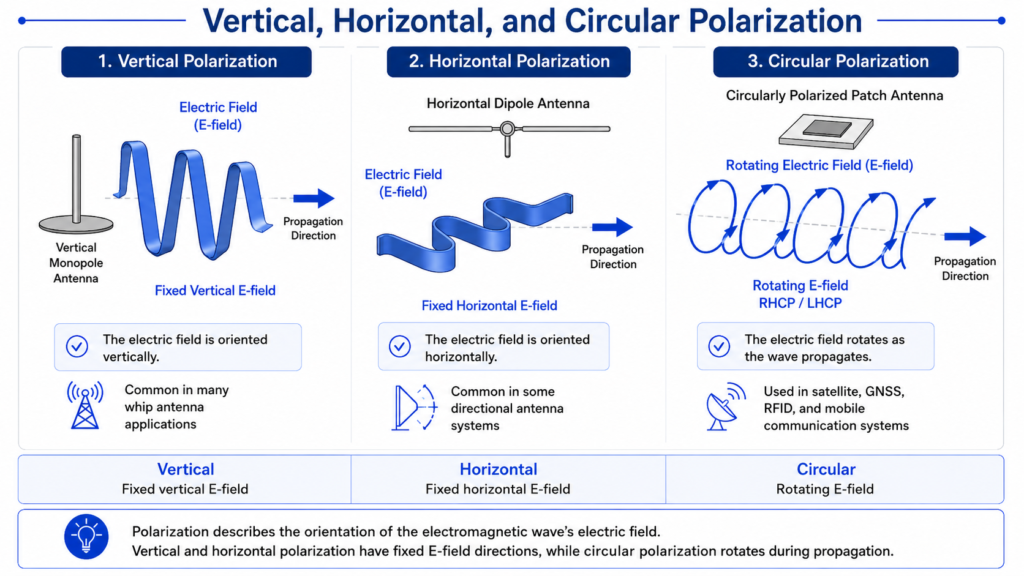
Antenna polarization describes the orientation of the electric field of the radio wave radiated by an antenna. In simple terms, it describes the direction in which the signal “vibrates” as it travels through space.
Antenna polarization is an important factor in wireless communication because the transmitting antenna and receiving antenna should have compatible polarization. If the polarization is not matched, signal strength can be reduced, even if the antennas are working on the correct frequency.
This is why antenna polarization should be considered during antenna selection, antenna installation, and custom antenna design.
Why Antenna Polarization Matters
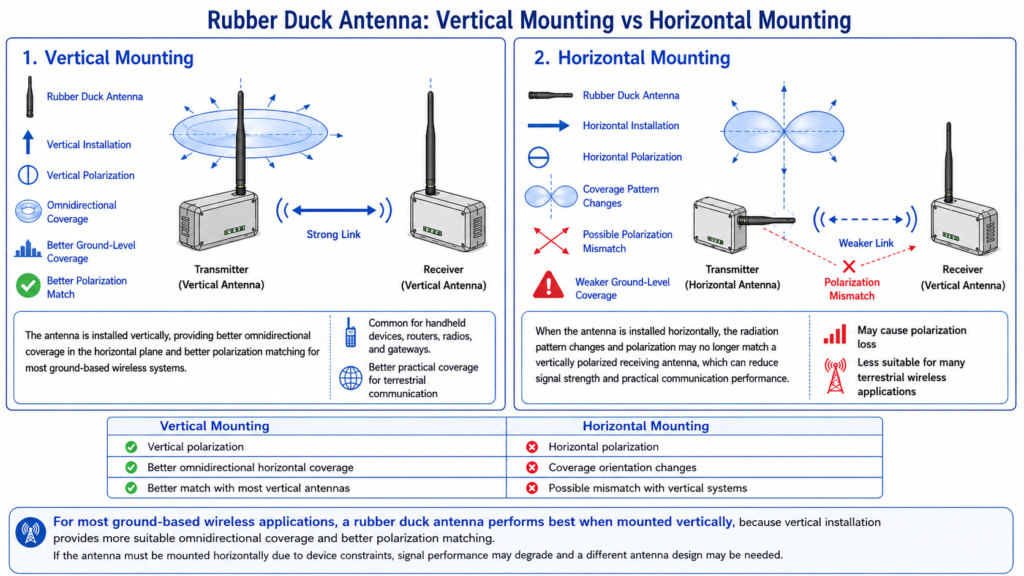
Wireless communication is not only about frequency, gain, or power. The orientation of the signal also matters. If one antenna transmits a vertically polarized signal and the receiving antenna is positioned for horizontal polarization, part of the signal may be lost.
This problem is called polarization mismatch. In real applications, polarization mismatch can reduce signal quality, shorten communication distance, and make wireless performance less stable.
For many wireless devices, simply changing the antenna orientation can affect the signal. This is common with rubber duck antennas, magnetic mount antennas, handheld devices, wireless modules, and IoT products.
Vertical Polarization
Vertical polarization is common in many wireless communication systems. For example, many rubber duck antennas and fiberglass antennas are designed to work vertically when mounted upright.
Vertical polarization is often used for general wireless communication, IoT devices, routers, gateways, and industrial wireless systems.
Horizontal Polarization
Horizontal polarization means the electric field is oriented horizontally. It is often used in some directional communication systems, point-to-point links, and specific installation environments.
The key point is that the transmitting and receiving antennas should normally use the same or compatible polarization for better performance.
Circular Polarization
Circular polarization means the electric field rotates as the wave travels through space. It can rotate in a right-hand or left-hand direction, commonly called RHCP and LHCP.
Circular polarization is often used in GNSS/GPS antennas because satellite signals can arrive from different angles and may be affected by reflection. A circularly polarized antenna can help provide more stable signal reception in positioning and navigation applications.
For products such as GPS trackers, navigation devices, drones, asset tracking devices, and timing systems, antenna polarization is an important design factor.
Antenna Polarization and Installation
Even a well-designed antenna may perform poorly if it is installed in the wrong orientation. For example, if a vertical antenna is placed horizontally, its performance may not match the expected coverage pattern.
Installation environment also matters. Metal surfaces, walls, device housings, and nearby components can change how the antenna radiates and receives signals. This can affect not only gain and efficiency, but also the effective polarization of the antenna in real use.
For embedded antennas such as PCB antennas and FPC antennas, the final device structure can strongly influence antenna behavior. This makes antenna testing and tuning especially important.
How to Choose the Right Antenna Polarization
When choosing antenna polarization, consider these questions:
- What type of wireless system is being used?
- Is the device fixed, handheld, or moving?
- What is the orientation of the transmitting and receiving antennas?
- Is the application indoor, outdoor, mobile, or satellite-based?
- Does the device use GNSS/GPS, WiFi, LoRa, LTE, or another wireless technology?
- Will the antenna be installed inside a compact device?
For many ground-based communication systems, linear polarization is common. For GNSS/GPS applications, circular polarization is often preferred. For directional links, polarization should be selected according to the link design and installation requirements.
When Custom Antenna Design Helps
Custom antenna design can help when antenna polarization, size, gain, frequency band, and installation method need to work together in a specific product.
A custom antenna solution may be needed when:
- The device orientation changes during use
- The antenna must be installed inside a compact housing
- Standard antennas cannot provide stable signal reception
- The product needs GNSS/GPS positioning performance
- The installation environment causes signal loss or reflection
- The antenna must match a specific radiation pattern and polarization
By considering polarization early in the design process, engineers can improve wireless performance and reduce integration problems before mass production.
FAQ
What does antenna polarization mean?
Antenna polarization describes the orientation of the electric field of the radio wave radiated or received by an antenna.
Why does antenna polarization matter?
It matters because mismatched polarization between transmitting and receiving antennas can reduce signal strength and communication stability.
What is the difference between linear and circular polarization?
Linear polarization keeps the electric field in one main direction, while circular polarization rotates as the wave travels through space.
What polarization is used for GPS antennas?
Many GNSS/GPS antennas use circular polarization to receive satellite signals more reliably from different angles.
Conclusion
Antenna polarization is an important part of RF antenna performance. It affects how well signals are transmitted and received, especially when antenna orientation, movement, reflection, and installation conditions are involved.
If your wireless device has special requirements for frequency, gain, polarization, size, or installation structure, our RF engineering team can help develop a custom antenna solution from design to production.