
Antenna impedance is an important parameter that describes how an antenna interacts with an RF system. In simple terms, antenna impedance affects how efficiently signal power is transferred from the transmitter to the antenna, or from the antenna to the receiver.
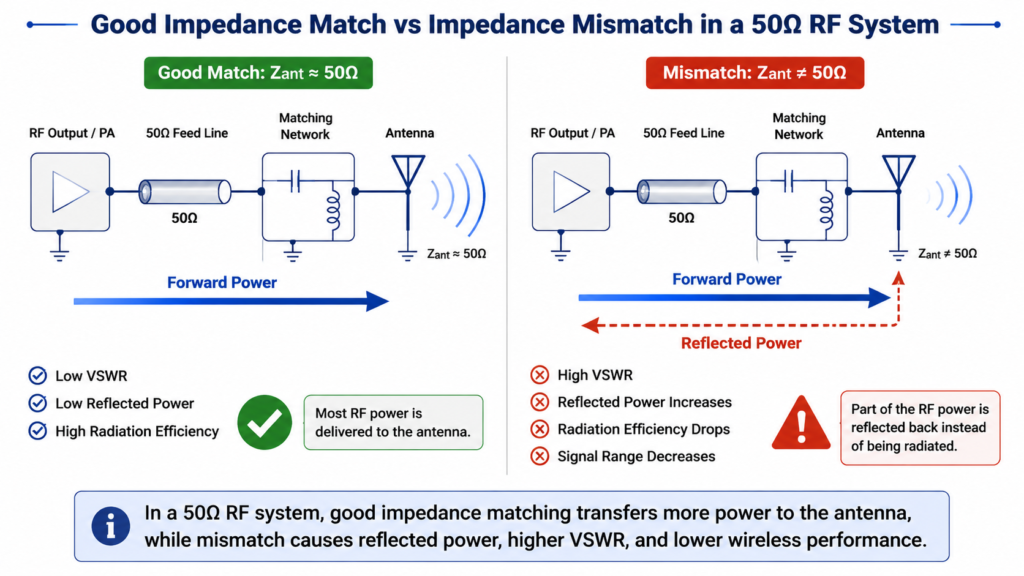
In most wireless devices, the antenna, cable, connector, and RF circuit are designed to work with a standard impedance, commonly 50 ohms. When the antenna impedance matches the RF system well, more signal energy can be delivered to the antenna and radiated into the air.
If the impedance is not properly matched, part of the signal energy may be reflected back instead of being transmitted or received effectively. This can reduce antenna performance, lower efficiency, and affect wireless communication stability.
Why Antenna Impedance Matters
Antenna impedance matters because wireless communication depends on efficient signal transfer. The RF circuit sends energy through a transmission line to the antenna. If the antenna impedance is close to the system impedance, the signal can move smoothly through the system.
If the impedance is mismatched, the signal path becomes less efficient. Some of the RF energy is reflected back toward the transmitter. This reflected energy can lead to higher VSWR, lower radiation efficiency, and weaker real-world performance.
For this reason, impedance matching is one of the most important steps in antenna design, antenna selection, and antenna tuning.
Why Are Many Antennas Designed for 50 Ohms?
Many RF systems use 50 ohms as a standard impedance because it provides a practical balance between power handling and signal loss. As a result, many antennas, coaxial cables, connectors, modules, and testing instruments are designed around 50 ohms.
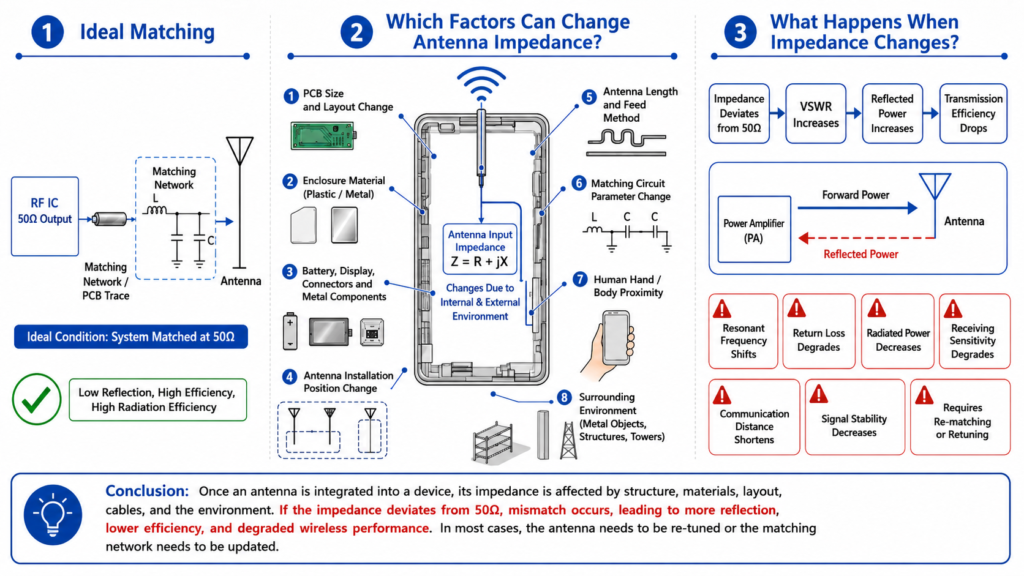
For wireless devices, using a 50 ohm antenna can make integration easier. However, the actual impedance of an antenna can change after it is installed inside the final product. The device housing, PCB layout, ground plane, battery, nearby metal parts, and cable position can all affect antenna impedance.
This is especially important for embedded antennas such as PCB antennas and FPC antennas. These antennas are strongly influenced by the structure of the device.
Antenna Impedance and VSWR
Antenna impedance is closely related to VSWR. VSWR stands for Voltage Standing Wave Ratio, and it is used to describe how well an antenna is matched to the RF system.
When antenna impedance is well matched, VSWR is usually lower. A lower VSWR means less signal reflection and better power transfer. When the impedance is poorly matched, VSWR becomes higher, which may indicate more reflected power.
However, impedance and VSWR should not be evaluated alone. A complete antenna evaluation should also include gain, efficiency, radiation pattern, and real installation testing.
What Can Affect Antenna Impedance?
Antenna impedance can be affected by many design and installation factors, including:
- Frequency band
- Antenna length and structure
- PCB layout and ground plane
- Matching circuit design
- Cable and connector type
- Plastic or metal housing
- Nearby batteries, screens, or metal parts
- Installation position inside the device
- Final assembly conditions
This is why an antenna that works well in free space may perform differently after being installed in a wireless device.
How Impedance Matching Improves Antenna Performance
Impedance matching helps reduce signal reflection and allows more RF energy to reach the antenna. Engineers may use matching components, such as capacitors and inductors, to adjust the antenna impedance and improve the match between the antenna and RF circuit.
For compact wireless devices, antenna tuning is often required after the antenna is installed in the final product. This process helps optimize impedance matching, VSWR, and overall antenna performance.
Good impedance matching can help improve signal stability, communication distance, and product reliability.
When Do You Need Custom Antenna Tuning?
You may need custom antenna tuning when:
- A standard antenna does not perform well after installation
- The device has limited space for the antenna
- The antenna is affected by metal parts or batteries
- The product uses a compact PCB or unusual housing design
- The VSWR value is too high in the target frequency band
- The device requires stable performance before mass production
In these cases, a custom antenna solution can help optimize the antenna structure, matching circuit, and installation position.
FAQ
What does antenna impedance mean?
Antenna impedance describes how an antenna interacts with the RF system and affects how efficiently signal power is transferred.
Why is 50 ohms common in antennas?
Many RF systems use 50 ohms as a standard because it provides a practical balance between power handling and signal loss.
What happens if antenna impedance is mismatched?
Impedance mismatch can cause signal reflection, higher VSWR, lower efficiency, and weaker wireless performance.
Can antenna impedance change after installation?
Yes. The housing, PCB, ground plane, metal parts, battery, and installation position can all change antenna impedance.
Conclusion
Antenna impedance is a key factor in RF antenna design. Proper impedance matching helps reduce signal reflection, improve VSWR, and support stable wireless performance.
If your wireless device has special requirements for frequency, size, installation space, impedance matching, or VSWR, our RF engineering team can help develop and tune a custom antenna solution from design to production.