
A high-gain parabolic antenna can provide substantial directional link gain, but the antenna itself is only one part of a successful remote cellular network.
This is especially true in Saudi Arabia.
Remote installations may be located on farms, construction sites, desert facilities, solar farms, oil and gas infrastructure, warehouses, CCTV stations, border areas, pumping facilities or industrial compounds.
In many of these projects, cellular infrastructure may be available, but the useful tower is far enough away—or the local installation environment difficult enough—that an ordinary indoor router does not provide a reliable connection.
A Saudi remote internet antenna project should therefore begin with a site survey and end with real application testing.
The process is:
Survey → Frequency → Tower → Antenna → Alignment → CPE → Local Network → Validation
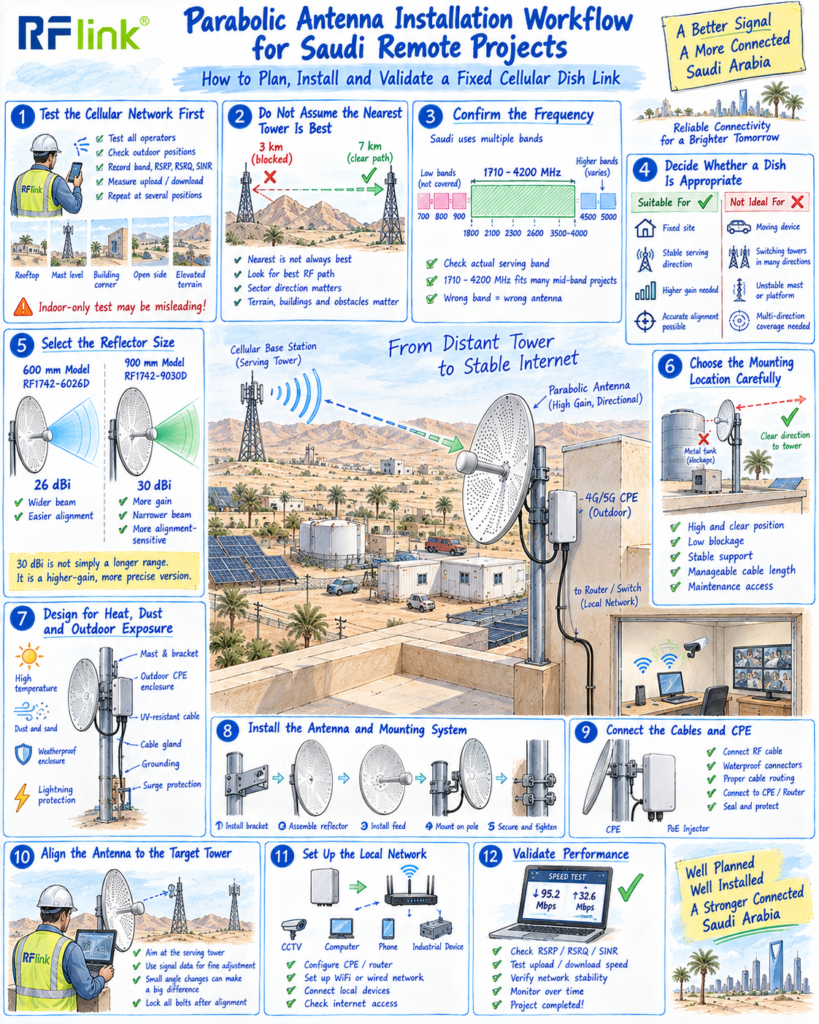
Step 1: Test the Cellular Network Before Buying the Antenna
Do not start by ordering the largest dish.
First determine what network actually exists.
Test all practical operators at the site.
Record:
- LTE or 5G band;
- RSRP;
- RSRQ;
- SINR;
- Cell ID / PCI;
- upload throughput;
- download throughput.
Repeat the measurement at several positions.
A measurement inside a steel container or concrete equipment room tells you very little about what an outdoor antenna could receive.
Useful test positions may include:
- rooftop;
- mast level;
- building corners;
- open side facing the expected tower;
- elevated terrain where safely accessible.
Step 2: Do Not Assume the Nearest Tower Is the Best Tower
This is one of the biggest mistakes in remote Saudi installations.
A base station 3 km away may be behind a ridge, building or unfavorable sector orientation.
Another tower 7 km away may have a much clearer path and a sector pointed toward the site.
Saudi Arabia includes large open desert regions, but it also includes mountains, wadis, urban structures, industrial sites and changing terrain.
Distance alone is therefore insufficient.
Look for the best RF path, not simply the shortest line on a map.
Step 3: Confirm the Frequency
Saudi Arabia uses multiple cellular frequency layers.
Current CST information includes low-band spectrum below 1 GHz as well as 1800, 2100, 2300, 2600 and 3500–4000 MHz mobile spectrum.
RFLink’s current parabolic platform covers 1710–4200 MHz.
That means it can match many Saudi mid-band projects but not every Saudi network.
If the useful remote cell is 700 MHz, the 1710–4200 MHz dish is the wrong antenna.
Confirm the band first.
Step 4: Decide Whether a Dish Is Actually Appropriate
A parabolic antenna is useful when:
- the site is fixed;
- the serving direction is stable;
- higher directional gain is needed;
- accurate alignment is possible.
It is less appropriate when:
- the device moves;
- the modem must switch among widely separated tower directions;
- several sectors in different directions must be received;
- the mast is unstable.
A directional architecture should solve a real RF problem.
Step 5: Select the Reflector Size
RFLink currently provides two main 1710–4200 MHz platforms.
The 600 mm RF1742-6026D provides 26 dBi peak gain.
The 900 mm RF1742-9030D provides 30 dBi.
The larger reflector provides more gain but also narrows the beam.
For a remote Saudi project, this means the 900 mm model is not simply “the longer-range version.”
It is the higher-gain, more alignment-sensitive version.
Use measured network data to determine whether the extra gain is necessary.
Step 6: Choose the Mounting Location Carefully
The ideal location should provide:
- clear direction toward the target sector;
- minimal nearby blockage;
- stable mechanical support;
- practical maintenance access;
- manageable RF cable length.
Avoid blindly choosing the highest available point.
A high installation behind a large metal tank can be worse than a slightly lower but clear position.
Saudi sites may contain:
- steel water tanks;
- container buildings;
- solar panels;
- metal roofing;
- towers;
- warehouse frames;
- heavy machinery.
These can all change the propagation environment.
Step 7: Design for Heat, Dust and Exposed Outdoor Conditions
A Saudi desert installation should treat environmental engineering seriously.
The antenna is only one outdoor component.
The full system may include:
- mast;
- brackets;
- connectors;
- coaxial cable;
- CPE enclosure;
- PoE equipment;
- grounding;
- surge protection;
- cable glands.
Heat, dust, UV exposure and wind can all affect system reliability.
Do not assume that one antenna specification automatically certifies the entire installed network for the environment.
Each component must be selected for the project conditions.
Step 8: Mast Stability Matters More With a Narrow Beam
A high-gain parabolic antenna has a relatively narrow radiation beam.
If the mast moves, the antenna moves.
Small movement matters more to a narrow-beam 30 dBi dish than to a broad omnidirectional antenna.
RFLink’s 900 mm product has published beamwidths narrower than the 600 mm model.
This is one reason mechanical engineering and RF engineering must be coordinated.
The mast should not simply be designed to “hold the weight.”
It should maintain pointing stability under expected environmental loads.
Step 9: Keep the CPE Close to the Antenna When Practical
Long coaxial feeder runs reduce received and transmitted RF power.
This is increasingly important toward the upper end of the cellular mid-band.
Compare two designs:
Antenna on mast → 20 m coax → indoor router
versus:
Antenna on mast → short coax → outdoor CPE → Ethernet/PoE to equipment room
The second architecture can substantially reduce RF feeder length.
Whether it is appropriate depends on the CPE’s environmental rating and maintenance requirements.
Step 10: Use Both MIMO Ports Correctly
The current RFLink parabolic platforms use dual-linear H and V polarization.
A compatible 2×2 MIMO CPE may require two RF connections.
Do not assume one cable is enough simply because “signal is strong.”
Check the router documentation.
Confirm:
- MAIN/AUX assignments;
- supported bands per port;
- connector type;
- cable length;
- whether both ports are active for the desired network mode.
Step 11: Align Using RSRP, RSRQ and SINR
Visual alignment is only the starting point.
Once the approximate tower direction is known:
- rotate the antenna slowly across the expected azimuth;
- pause after each adjustment;
- record network measurements;
- adjust elevation;
- repeat using smaller angular changes;
- test real throughput.
Do not maximize RSRP alone.
A stronger signal with poor SINR can perform worse than a slightly weaker but cleaner link.
For real internet use, evaluate:
- RSRP;
- RSRQ;
- SINR;
- upload;
- download;
- latency;
- stability.
Step 12: Test at Different Times
A base station can perform very differently at different times of day.
A perfect midday speed test does not guarantee evening performance.
Operator cell loading affects throughput.
For business-critical remote connectivity, test the network over representative periods.
Remote Saudi Farm Example
Consider a farm where:
- indoor router signal is weak;
- the roof detects a stable 1800/2100/2600 MHz service;
- the useful tower is in one fixed direction;
- internet is needed for office users, CCTV and IoT equipment.
The architecture could be:
Tower → Parabolic → 4G/5G CPE → Router/Switch → WiFi APs + CCTV + IoT Gateway
The parabolic handles the cellular WAN.
The WiFi APs handle local coverage.
The CCTV uses the local LAN.
This separation makes troubleshooting much easier.
Saudi Construction Camp Example
Construction sites can change constantly.
Containers move.
Cranes appear.
Metal equipment is added.
Temporary buildings change location.
A parabolic antenna can provide a stable upstream cellular link, but the installer should choose a position less likely to become blocked by future construction.
Local WiFi coverage should then be expanded separately as the camp grows.
Saudi Solar Farm Example
Solar installations often cover very large areas.
The central control building may need internet for:
- CCTV;
- inverter monitoring;
- weather data;
- alarms;
- maintenance access.
A directional cellular CPE can provide WAN connectivity at the control point.
Local networking can then be distributed by fiber, Ethernet or wireless links.
Do not attempt to make one cellular parabolic antenna directly serve every field device.
Saudi CCTV and Remote Security Example
Cameras create substantial upload traffic.
Therefore the project should not judge network quality from download speed alone.
Run the real video stream.
Test:
- sustained uplink;
- packet loss;
- latency;
- reconnect behavior;
- nighttime operation;
- simultaneous cameras.
A dish that produces a good RSRP value but cannot sustain the required upload is not a successful solution.
26 dBi vs 30 dBi in Saudi Remote Sites
Choose 26 dBi when the link needs strong directional gain but the additional 4 dB is not essential.
Choose 30 dBi when measured data demonstrates that more link margin is useful and the mounting system can support the narrower beam.
The decision should be based on engineering data, not marketing.
Should Saudi Customers Use a Signal Booster Instead?
A booster/repeater and an external CPE antenna are different system architectures.
A CPE-based solution directly connects the cellular modem to the external antenna and then distributes data through Ethernet/WiFi.
This can be easier to engineer for data connectivity because the antenna, modem and network performance can be measured as one system.
Repeater use also introduces regulatory and network considerations that should be checked locally.
For fixed broadband projects, an outdoor antenna + CPE architecture is often worth evaluating first.
Installation Checklist
Before locking the antenna in place:
- confirm operator;
- confirm band;
- confirm serving cell;
- verify both RF ports;
- minimize cable length;
- check azimuth;
- check elevation;
- tighten mast hardware;
- retest signal quality;
- run upload/download;
- test real application traffic.
Photograph and record the final antenna direction for future maintenance.
What Information Should RFLink Receive for a Saudi Project?
For faster antenna evaluation, provide:
- Saudi city/region;
- application;
- CPE/router model;
- working bands;
- operator;
- outdoor signal measurements;
- required reflector size;
- cable/connector requirement;
- mounting dimensions;
- estimated order quantity.
For projects requiring a special frequency or mechanical configuration, RFLink can provide custom antenna development.
FAQ
How do I point a parabolic antenna at a Saudi cellular tower?
Start with the approximate tower direction, then fine-tune azimuth and elevation while monitoring RSRP, RSRQ, SINR and real throughput.
Is a larger dish always better in the Saudi desert?
No. A larger dish provides higher directional gain but has a narrower beam and greater alignment sensitivity.
Does desert terrain guarantee line of sight?
No. Dunes, ridges, buildings and local elevation changes can still affect the path.
Should the router be inside the building?
It can be, but long coaxial cable introduces RF loss. In some projects an outdoor CPE close to the antenna is preferable.
What Saudi applications use parabolic cellular antennas?
Remote broadband, farms, construction camps, CCTV, energy sites, industrial facilities and fixed cellular CPE installations are common candidates.
Conclusion
Installing a Saudi remote internet antenna successfully is not about attaching the biggest reflector to the highest pole.
The project must identify the correct operator, serving cell and frequency first.
Then the installer must choose the antenna gain, mounting height, reflector size, CPE architecture and cable layout.
Finally, the antenna should be aligned using real network data and tested with the real application.
For many Saudi remote sites, a high-gain directional antenna can turn a marginal fixed cellular link into a more usable connection.
But the result comes from the complete RF system, not the dish alone.